Protected view is a new security feature for all Office documents which arrive in email or are downloaded from Internet sources. This is a security sandbox used by Office 2010 to enhance attachment security. Administrators will be able to control whether all email attachments or only those from outside their Exchange network use Protected view.
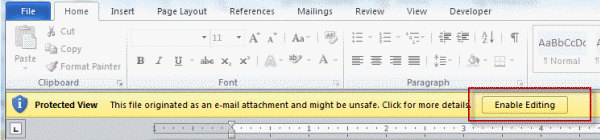
How it works: When an emailed (or downloaded) document is opened, a red band appears at the top of the document to alert the user that the document is in protected view and cannot be edited. If the user trusts the document, they click the Enable editing button to begin editing. All attachments are read-only.
When a document that was previously attached to an email (or downloaded from the Internet) is opened, the red message bar states "This file originated as an email attachment " or "This file was downloaded from the Internet". The application knows this because Windows uses the Attachment Execution Service to place a zone identifier in an alternate data stream of the file which indicates it was downloaded from the Internet Zone. When Word, Excel, or PowerPoint opens the file and sees this marker it knows to open the file within Protected View and the user sees the red bar.
This setting opens all Office documents in a read-only state and you need to click a button before you can edit the document. (To save the document, you'll need to use Save as - see "Edit and Save Outlook's Read-Only Attachments" if you want to save documents back to the email message.)
To change the Protected view setting, you need to make the change in each Office application.
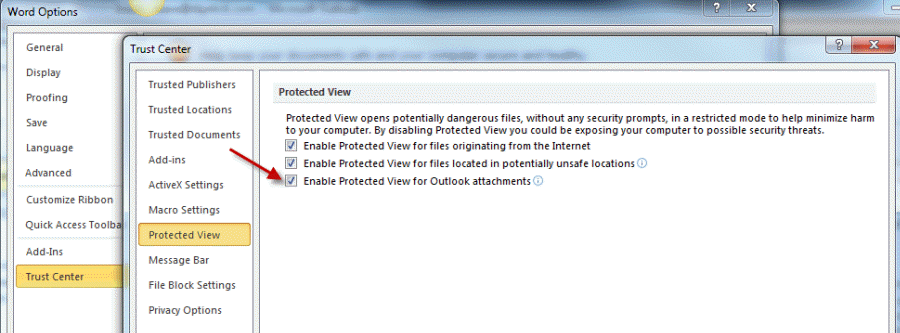
Go to the File, Options Trust Center dialog and select Protected View. Disable the option to enable it for Outlook attachments. (You may also want to disable it for files originating from the Internet.)
Once you do this, you'll get the Open/Save dialog, which can be disabled by editing the registry. The instructions to do this are below.
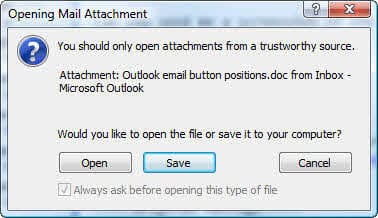
Disable the Open Save dialog
Note: I recommend making this change only for the document types you open often.
In each of the following keys, add or edit the EditFlags binary value so the value is 00 00 01 00
HKEY_LOCAL_MACHINE\SOFTWARE\Classes\Excel.Sheet.12
HKEY_LOCAL_MACHINE\SOFTWARE\Classes\PowerPoint.Show.12
HKEY_LOCAL_MACHINE\SOFTWARE\Classes\Word.Document.12
Or use our prepared reg file that sets the EditFlags value for Word (docx, doc), Excel (xlxs, xls) and Powerpoint (ppts, ppt) files.
EditFlags for Word, Excel, and Powerpoint
For more information, see Restore (or Hide) the Open Save Dialog

James Martin says
As a test I did the Macro X in Excel, it works, and possibly the References are better for me as the ScreenUpdating is not lowercase:
Sub ExcelFileClose()
'SOURCE: james.martin@birmingham.gov.uk jam61mar@gmail.com
'May be simpler vba to do this but I could not work out other methods, this works.
Dim ProtectedViewWindow
Application.ScreenUpdating = False
If Excel.Application.ProtectedViewWindows.Count >= 0 Then GoTo Normal
'this formula counts open and recent (viewable via right clicking on WordApp in Taskbar).
Protected: If Excel.Application.Workbooks.Count >= 0 Then GoTo NoDoc
NoDoc: If Excel.Application.ProtectedViewWindows.Count = 0 Then
Exit Sub
End If
Excel.Application.ActiveProtectedViewWindow.Edit
Excel.ActiveWorkbook.Close
Exit Sub
Normal: On Error GoTo Protected
Excel.ActiveWorkbook.Close
Exit Sub
Application.ScreenUpdating = False
End Sub
James Martin says
Couldn't add to my first reply just now:
Sub WordFileClose()
Word.Application.screenupdating = False
'SOURCE: jam61mar@gmail.com
'May be simpler vba to do this but I could not work out other methods, this works.
Dim ProtectedViewWindow
If Word.Application.ProtectedViewWindows.Count >= 0 Then GoTo Normal
'this formula counts open and recent (viewable via right clicking on WordApp in Taskbar).
Protected: If Word.Application.Documents.Count >= 0 Then GoTo NoDoc
NoDoc: If Word.Application.ProtectedViewWindows.Count = 0 Then
Exit Sub
End If
Word.ActiveProtectedViewWindow.Edit
Word.ActiveDocument.Close
Exit Sub
Normal: On Error GoTo Protected
Word.ActiveDocument.Close
Exit Sub
Word.Application.screenupdating = True
End Sub
James Martin says
I resolved Protected View in a simple macro which I call Macro X for Word. I have the "X" symbol on the Quick Access Toolbar. Basically I resolved multiple Word Apps in your Slipstick Macro to save an Outlook Item to docx (followed the changes to the pdf version and to add the email header). and your save attachments to a temp folder. I use another macro from another site to import the images to the active docx.
Basically I don't want to close down Active Word App with the right hand top corner X. as this drains the computer and you can get multiple Apps open. So I wanted to replace Word>>> File >>>Close with a single click on the QAT. The macro is straight forward for a normal word or rtf file that is active. The code to do nothing if accidently pressed if no file is open in the Word App is also not too difficult. But with Protected documents that we download from a client online browser database, to check, the macro did not recognise a word file. So I had to make it editable before closing. Unfortunately the active window can not be counted definitively that it has a protected view file. Only any protected view file in any window is counted and even in the Recent list if you right click the Word App. Anyway I used some workarounds to trap each possibility. This looks a bit mad to go to this much trouble. But I use this all day and as soon as I use it 53 times, for my standard work hours this saves 2% of my working day if 10 seconds is saved on average every time. I use this a couple of hundred times a day... This is not the main time saving macros I use... (I have problems with ScreenUpdating going lowercase - not resolved yet):
Dan Mortenson says
Have a new install of Office 2016 on a small office, one user is fine, the other user is getting
"Word experienced an error trying to open the file.."
I have turned off protected view and repaired Office but the error persists.
It was an upgrade from Office 2007.
This error occurs outside of Outlook if the attachment is saved locally.
Diane Poremsky says
Did you right click on the file and select properties then click unblock? This is a security feature for attachments from outside sources.
susan says
Hi. I keep getting this message
Outlook blocked access to the following potentially unsafe attachment. I have received .xls files from this email address for over 10 years, but it will not let me open them, what do I need to do?
Diane Poremsky says
That sounds like the new security patch from June 13 broke it. Did you ever set a lwvel1remove key for that file type? The patch is ignoring the key - it should be fixed in the updates coming out this week. (That key is not needed for xls files.)
https://www.slipstick.com/outlook/updates/outlooks-june-13-2017-security-update/
https://support.office.com/en-us/article/Outlook-known-issues-in-the-June-2017-security-updates-3f6dbffd-8505-492d-b19f-b3b89369ed9b
Mark Cabaneiro says
already disabled the protective view settings and my excel still hanging....what should i do?
Diane Poremsky says
What addins do you have installed? Does Excel hang other times?
Tinus says
Protected view option missing in OUTLOOK. How can this be fixed. I cannot open any attachment from in outlook.
Diane Poremsky says
That option is set within each office app and applies to their file types. Are all attachments affected, word, psf, excel, jpg, etc? It's unlikely to be protected view if pdf and images are also affected.
Any error messages?
D Gott says
my problem is that I cant receive an excel file which has a pass word on it. I get the following warning. “The original message contained a virus. The virus has been cleaned. You may want to notify the sender of the virus.” but we had received the same document earlier without problems when it contained no pass word.
David says
This did not work. Something else must be forcing read only.
Donna Nock says
Unfortunately, I no longer have a protected view line to click on.
Diane Poremsky says
Are you looking at the Excel options? Protected view is an set in each application, not Outlook.

Donna Fournier Nock says
How do I re-enable the protected view for Excel files in Outlook? I want to be able to decide to unprotect a spreadsheet instead of them automatically being unprotected.
Diane Poremsky says
This is set in Excel's File, Options, Trust Center, Protected View
aberman7@gmail.com says
Prepared to be stumped :)
I've been locking down printing of excel files at work, via gpo.
I've plugged every whole but one - when inserting an excel file in outlook, a user can right click on the file and choose quick print which will shell out, open excel and and pass a print command, circumventing everything :( There are control identifiers to block quick print from right clicking on an attachment in outlook, but that only works on a received email, not when inserting an excel file as an attachment prior to sending.
Diane Poremsky says
So everything is blocked if you open the file directly in Excel but not if you open the Excel file from Outlook?
ERCarrera says
Dear Ms. Diane Poremsky,
I have been breaking my brain trying to get the Protected View to show up on the Trust Center in Outlook 2013 (Office 2013 Pro Plus) running on Windows 7 x64. I have searched and searched to no avail to find the cause of this. My office will not repair itself as well even with a disc insterted.
Please help!
Diane Poremsky says
Protected View should be on the attachment's Trust center dialog, not Outlook's.
Diane Poremsky says
Oh, and on repair - does repair not fix it or is repair not an option? A recent update - we think the ones in the bad update on Sept 13 -removed Repair as a option (unintentional).
AJ says
This was helpful, however, after removing the checkboxes in the Trust Center under PowerPoint, I am still getting a hang from Powerpoint, when opening files directly from an email attachment. If it is saved locally first, there is no issue.
Diane Poremsky says
It's possible the hang is unrelated to the protected view settings. What antivirus do you use? Outlook saves the files to the securetemp folder, where they are scanned before opening.
Also, have you tried repairing your office installation?
Mark Fonseca says
I am trying to remove the "Opening Mail Attachment" dialog that comes up when opening attached PDFs in Outlook 2013. Is that possible?