• Outlook User
  • New Outlook app
  • Outlook.com
  • Outlook Mac
  • Outlook & iCloud
  • Developer
  • Microsoft 365 Admin
    • Common Problems
    • Microsoft 365
    • Outlook BCM
    • Utilities & Addins

Assigning Exchange Administrator Roles

Slipstick Systems

› Exchange Server › Assigning Exchange Administrator Roles

Last reviewed on September 8, 2011     No Comments

Applies to: Exchange Server

Just as Microsoft introduced roles for Exchange 2007 installations, they also introduced specific roles for Exchange 2007 Administration. Assigning one of these roles replaces the Exchange Delegation Wizard from Exchange 2000/2003 and their three predefined levels of Exchange Full Administrator, Exchange Administrator and Exchange View-Only Administrator:

  • Exchange Organization Administrators
  • Exchange Recipient Administrators
  • Exchange View-Only Administrators
  • Exchange Server Administrators
  • Exchange Public Folder Administrators

The Exchange Public Folder Administrator role is added in Exchange 2007 sp1. After installing Exchange 2007, administrator roles can be assigned to users or groups. In the Exchange Management Console (EMC), navigate to the Organization Configuration container. Select ‘Add Exchange Administrator’ from the Right Click context menu or the Action Pane in the EMC. This will launch a very simple screen shown in Figure 1.
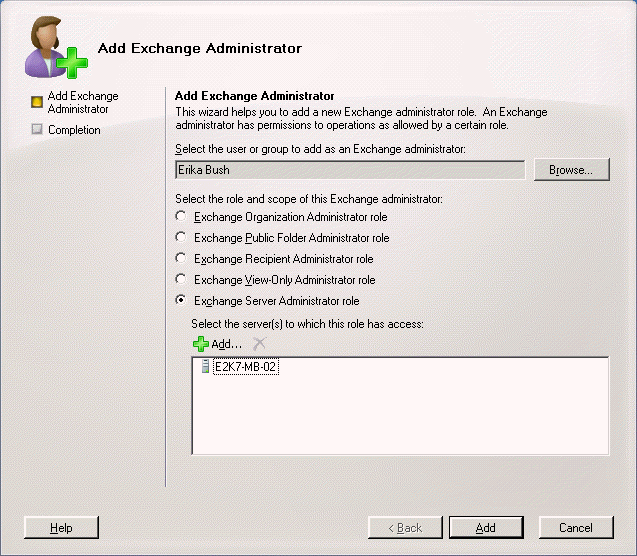
Figure 1 Exchange dialog

Select the user or group to assign the role to. In the GUI, you have to select the user or group using the navigation window, and you can not assign multiple users or group objects at one time. You would use the interface once for each user or group you want to assign an administrator role to. You can only assign a single role at a time as well. If Exchange Server Administrators is selected, then the section to select an Exchange Server is activated. The Exchange Server Administrator role is not so much a formal role as a means of restricting another role, especially the View Only Administrator role, to a single Exchange server or servers.

When Exchange is installed, it adds a container in Active Directory called Microsoft Exchange Security Groups. Membership in these groups forms the roles assigned through Exchange 2007.

Assigning Exchange administrator roles can also be done using the Exchange Management Shell. Of course, everything you can do in the EMC you can accomplish using PowerShell cmdlets. Adding an Exchange Administrator role is done as follows:

> Add-ExchangeAdministrator -Identity “domain/org_unit/username” -Role “admin_role_name”

The different roles for this cmdlet are listed as OrgAdmin, ServerAdmin, RecipientAdmin, ViewOnlyAdmin, and PublicFolderAdmin. Again, the latter is added with Exchange 2007 sp1. The ServerAdmin role requires assigning the -scope parameter as well defining the server for the role.

Exchange Organization Administrators

This is the grand daddy of Exchange administrator roles with authority over the entire Exchange organization. Any global settings affecting the Exchange organization will require this role, including the ability to assign other Exchange Administrator roles.

Exchange Recipient Administrators

As the name suggests, this role is assigned for administrators to manage Exchange recipients. They have read access to the Domain Users container in AD with write access to Exchange attributes. This requires setup with the PrepareDomain switch in every domain where Exchange users exist.

Exchange View-Only Administrators

This role allows read access only to Exchange organization container and containers with Exchange recipients in AD. They can verify settings, but can not change or add any settings.

Exchange Public Folder Administrators

Added with Exchange 2007 service pack 1, the name basically says it all. This role allows delegation of administration of public folders without allowing any other Exchange administration permissions. Basic Public Folder control is granted such as creating and deleting public folders and controlling folder attributes, like quotas and access.

Assigning Exchange Administrator Roles was last modified: September 8th, 2011 by Guest Author
Post Views: 36

Share this:

  • Share on Facebook (Opens in new window) Facebook
  • Share on X (Opens in new window) X
  • Share on Reddit (Opens in new window) Reddit
  • Share on Bluesky (Opens in new window) Bluesky
  • Share on Mastodon (Opens in new window) Mastodon
  • Email a link to a friend (Opens in new window) Email

Related Posts:

  • Exchange 2007 Server Role Review
  • Exchange 2007 Message Transport Rules
  • Set a Default Microsoft Exchange Public Folder View
  • Sharing an Exchange Server Calendar with Customers?

About Guest Author

If you would like to submit guest articles to Slipstick.com, please contact us through our Feedback form. Please note: article suggestions that are not specifically about Outlook and/or Exchange Server will not be acknowledged.

Leave a Reply Cancel reply

Your email address will not be published. Required fields are marked *

Visit Slipstick Forums.
What's New at Slipstick.com

Latest EMO: Vol. 31 Issue 8

Subscribe to Exchange Messaging Outlook


Support Services

Do you need help setting up Outlook, moving your email to a new computer, migrating or configuring Office 365, or just need some one-on-one assistance?

Our Sponsors

CompanionLink
ReliefJet
  • Popular
  • Latest
  • Week Month All
  • Deleting Auto-Complete Entries No Longer Works
  • Use Classic Outlook, not New Outlook
  • How to Remove the Primary Account from Outlook
  • How to Hide or Delete Outlook's Default Folders
  • Removing Suggested Accounts in New Outlook
  • Reset the New Outlook Profile
  • Disable "Always ask before opening" Dialog
  • Change Outlook's Programmatic Access Options
  • Adjusting Outlook's Zoom Setting in Email
  • Understanding Outlook's Calendar patchwork colors
  • Deleting Auto-Complete Entries No Longer Works
  • Sync Issues and Errors with Gmail and Yahoo accounts
  • Error Opening iCloud Appointments in Classic Outlook
  • Opt out of Microsoft 365 Companion Apps
  • Mail Templates in Outlook for Windows (and Web)
  • Urban legend: Microsoft Deletes Old Outlook.com Messages
  • Buttons in the New Message Notifications
  • Move Deleted Items to Another Folder Automatically
  • Open Outlook Templates using PowerShell
  • Count and List Folders in Classic Outlook
Ajax spinner

Recent Bugs List

Microsoft keeps a running list of issues affecting recently released updates at Fixes or workarounds for recent issues in classic Outlook (Windows).

For new Outlook for Windows: Fixes or workarounds for recent issues in new Outlook for Windows .

Outlook for Mac Recent issues: Fixes or workarounds for recent issues in Outlook for Mac

Outlook.com Recent issues: Fixes or workarounds for recent issues on Outlook.com

Office Update History

Update history for supported Office versions is at Update history for Office

Outlook Suggestions and Feedback

Outlook Feedback covers Outlook as an email client, including Outlook Android, iOS, Mac, and Windows clients, as well as the browser extension (PWA) and Outlook on the web.

Outlook (new) Feedback. Use this for feedback and suggestions for Outlook (new).

Use Outlook.com Feedback for suggestions or feedback about Outlook.com accounts.

Other Microsoft 365 applications and services


New Outlook Articles

Deleting Auto-Complete Entries No Longer Works

Sync Issues and Errors with Gmail and Yahoo accounts

Error Opening iCloud Appointments in Classic Outlook

Opt out of Microsoft 365 Companion Apps

Mail Templates in Outlook for Windows (and Web)

Urban legend: Microsoft Deletes Old Outlook.com Messages

Buttons in the New Message Notifications

Move Deleted Items to Another Folder Automatically

Open Outlook Templates using PowerShell

Count and List Folders in Classic Outlook

Newest Code Samples

Open Outlook Templates using PowerShell

Count and List Folders in Classic Outlook

Insert Word Document into Email using VBA

Warn Before Deleting a Contact

Use PowerShell to Delete Attachments

Remove RE:, FWD:, and Other Prefixes from Subject Line

Change the Mailing Address Using PowerShell

Categorize @Mentioned Messages

Send an Email When You Open Outlook

Delete Old Calendar Events using VBA

Repair PST

Convert an OST to PST

Repair damaged PST file

Repair large PST File

Remove password from PST

Merge Two Data Files

Sync & Share Outlook Data

  • Share Calendar & Contacts
  • Synchronize two computers
  • Sync Calendar and Contacts Using Outlook.com
  • Sync Outlook & Android Devices
  • Sync Google Calendar with Outlook
  • Access Folders in Other Users Mailboxes

Diane Poremsky [Outlook MVP]

Make a donation

Mail Tools

Sending and Retrieval Tools

Mass Mail Tools

Compose Tools

Duplicate Remover Tools

Mail Tools for Outlook

Online Services

Calendar Tools

Schedule Management

Calendar Printing Tools

Calendar Reminder Tools

Calendar Dates & Data

Time and Billing Tools

Meeting Productivity Tools

Duplicate Remover Tools

Productivity

Productivity Tools

Automatic Message Processing Tools

Special Function Automatic Processing Tools

Housekeeping and Message Management

Task Tools

Project and Business Management Tools

Choosing the Folder to Save a Sent Message In

Run Rules on messages after reading

Help & Suggestions

Submit Outlook Feature Requests

Slipstick Support Services

Buy Microsoft 365 Office Software and Services

Visit Slipstick Forums.

What's New at Slipstick.com

Home | Outlook User | Exchange Administrator | Office 365 | Outlook.com | Outlook Developer
Outlook for Mac | Common Problems | Utilities & Addins | Tutorials
Outlook & iCloud Issues | Outlook Apps
EMO Archives | About Slipstick | Slipstick Forums
Submit New or Updated Outlook and Exchange Server Utilities

Send comments using our Feedback page
Copyright © 2026 Slipstick Systems. All rights reserved.
Slipstick Systems is not affiliated with Microsoft Corporation.