Using Microsoft Outlook, you can create rules to reply automatically to incoming messages with the Rules Wizard and Out of Office Assistant.
If you don't use an Exchange server mailbox (Outlook.com and Office 365 are on Exchange), you can create automatic reply rules using Rules Wizard but will need to leave Outlook open and collecting email. For this reason, it's usually better to create automatic reply rules on your email server, if supported.
Out of Office Assistant | Other Rules Wizard Configurations | Notes | More Information
Using Out-of-Office Reply without Exchange
We are often asked:
"Can I create an "out of office" message if I'm not on a Microsoft Exchange server?"
Yes, you can do it using a rule that replies using a specific template, but it's often better to set up a "vacation reply" on your email server. (Many POP3 and IMAP mail servers support this.)
- Open a new message and enter your automatic reply message.
- Save the message using File, Save as and choose Outlook Template (.oft) format.
- Open Rules & Alerts then tap New to create a rule.
- Choose Apply Rule on messages I receive to create a blank rule. Click Next.

- Choose your conditions or click Next to apply the rule to all messages you receive.
- Tick Reply using a specific template from the Actions list.

- Click on specific in lower pane then select your template.
- In the Select Template dialog, choose User Templates in File system at the top.
- Select your template then click Open.
- Click Next to add exceptions or Finish to complete the rule.
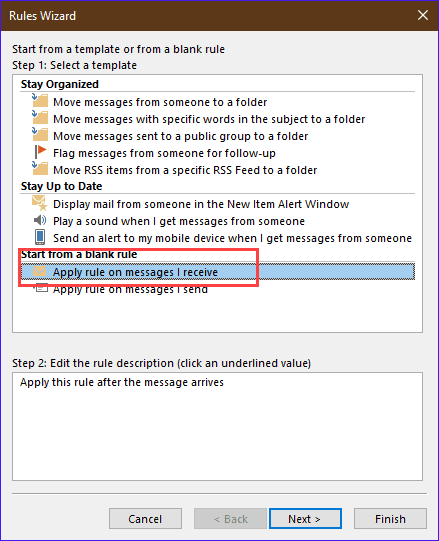
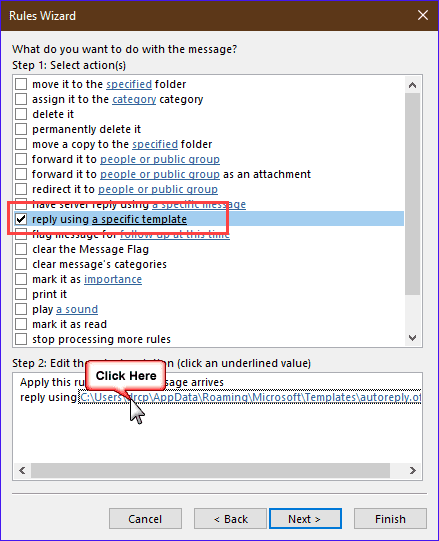
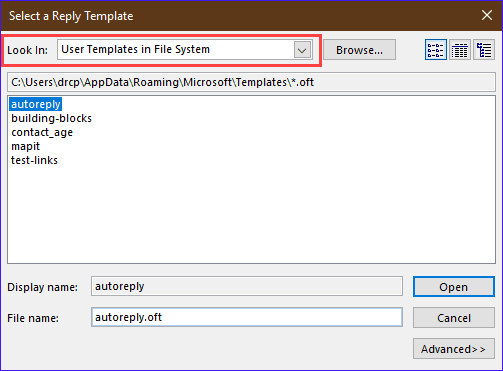
This will only reply to email after Outlook downloads mail. This means you need to leave your computer turned on and Outlook needs to connect to the Internet regularly to check for new mail. It's much easier and safer to set up an automatic reply on your mail server, if your server supports it. (Many do.) Look for the option to create a "vacation reply", as this is the common terminology used on many servers.
To use a Run a script rule to emulate an Out of Office reply, see Run a Script Rule: Send a new message when a message arrives or Run a script rule: Autoreply using a template . Using run a script will send a reply with every message that meets the condition of the rule.
Using Automatic Replies with Exchange Server
Automatic replies, formerly known as Out of Office Assistant, is available only if you connect to Microsoft Exchange Server, which includes Office 365, Outlook.com, and on-premise Exchange servers. Automatic replies sends a response (just once) to each message sent to you and also executes other rules that you set up in the Automatic Replies dialog. You should always fill in the response text; otherwise, your correspondents will receive a blank message in return.
An Exchange server administrator can control automatic replies to Internet addresses:
"I set a rule in Outlook to send an auto response email when any email arrives. This is working fine for internal emails and when I send an email from my another corporate account an auto reply is sent. But when I test it using a Gmail account, I don't receive a response in my Gmail account. "
This is typical behavior with Exchange accounts. Most administrators have automatic replies to Internet addresses blocked on the Exchange server. To check the settings, the administrator will look at the default remote domain in Exchange Management Console (under Organization Configuration > Hub Transport). The administrator can create remote domains for domains that should receive automatic replies.
Sending Multiple Autoreplies to One Address
Outlook sends just one automatic reply to an address until it is closed and restarted. Outlook does this to prevent a mail loop, where it and the recipient's email client send automatic replies back and forth until one side stops, often because one mailbox is full or the mail server crashes.
If you need to send replies to all messages you receive, you'll need to find another solution or use a macro or add-in. If you need to use a rule, use a "run a script" rule.
Other Outlook Configurations with Rules Wizard
Before creating a reply rule, you need an Outlook template file containing the text and subject of the reply. To create the template, make sure that you are not use Word as your e-mail editor (Tools | Options | Mail Format), because WordMail does not allow you to save messages as Outlook templates. Create a new Outlook message, then add your own subject and text. You can also add Bcc and Cc addresses. Then use File | Save As to save it as an Outlook template .oft file.
When you create your reply, you'll be asked to specify the location of the reply template -- that's your .oft file.
Several issues on Rules Wizard replies in such configurations:
- Rules Wizard replies are a client-only function, because they depend on the .oft file. If you use Exchange Server and want replies to run from the server, you must disable Rules Wizard and use Inbox Assistant instead.
- Only one reply per address is sent, no matter how many times someone sends to you. This means that Rules Wizard replies actually work like the Out of Office Assistant replies. However, it also means that, when you're testing reply rules by sending to yourself, you must exit Outlook and then restart. Otherwise, after the first test, you won't see any replies to other messages you send yourself.
- If you want the replies to go out automatically, say while you're on vacation, you need to leave Outlook running and make sure that it is set up to send and receive messages automatically.
Notes
The Folder Assistant for Exchange Server public folders, found on the folder's Properties dialog, can create many of the same types of rules as Inbox Assistant.
In an Exchange Server environment, automatic forwarding and replies to the Internet may be disabled at the server level. Consult your Exchange administrator if automatic replies are working to internal recipients, but not those one the Internet.
Replies are sent to the original sender of the message. Outlook ignores any Reply To address.
In Outlook 98 and Outlook 2000 in Corporate/Workgroup mode, automatic replies are not saved to the Sent Items folder.
Tools
Email Responder plug-in for Microsoft Outlook is an out-of-office assistant. Auto reply with away message templates; change your status and reply templates remotely. Change or schedule your free-busy status manually (Away, Out of Office, Vacation, Tentative, Custom) or use you Microsoft Outlook Calendar or Skype availability status. Auto response to selected Contacts or Distribution lists only. Enable Microsoft Outlook auto forward. Windows 10 and Outlook 2016 support. | |
Auto-Mate is an Outlook utility that allows you use define rules to move mail from your Inbox (or other folders) based on several criteria, including the age of the message. While Outlook rules only run as messages are downloaded or when you click Run Rules now, Auto-Mate rules run on a schedule, enabling you to apply rules to messages that have been in your Inbox for a given number of hours, days or weeks. Available in Standard or Pro Version. Outlook O365, Outlook 2019 as well as Outlook 2010, 2013, 2016, 32 and 64 bit editions. Version 12. | |
AutoReply 365 works with Office 365 and has the following features: The subject line of autoreply message consists of "Autoreply:" prefix and the Subject line of original message. The body of autoreply message includes the original message text. You can set any From: address for autoreplies. You don't need to create a shared mailbox for autoreplies. | |
AutoReply Flow checks the original message for a Reply-To: address field. If one is found then an auto-reply message will be sent to this address. If an original message has no Reply-To: address field then an auto-reply message will be sent to the From: address of the original message. The subject line of the auto-reply message consists of the prefix ("Confirmation:", "Autoreply:" etc) and the Subject line of original message; the body of auto-reply message will include the original message text. |
More Information
- Automatic Messaging Processing Tools -- tools to automate replies, among other functions

Tee says
"Only one reply per address is sent, no matter how many times someone sends to you. This means that Rules Wizard replies actually work like the Out of Office Assistant replies. However, it also means that, when you're testing reply rules by sending to yourself, you must exit Outlook and then restart. Otherwise, after the first test, you won't see any replies to other messages you send yourself."
Wow - only one reply per address is sent per Outlook session? I did not know this and your web page seems to be the only place on the internet where this factoid appears. This helped me troubleshoot and solve a problem. Thanks for including this piece of obscure information.
reyhan says
thanks alot of information
Ahsan Ali Shahid says
Hi Diane,
I am using Microsoft Outlook16.6 on my MacBook. I want to set an autoreply on the emails with certain keywords.
I have created a reply template but unable to find the autoreply in rules.
Can you please guide me how can it be arranged?
Diane Poremsky says
The mac version doesn't have a reply with template action - only windows - it does have a reply with message action though, that should meet your needs. Click on Reply text... to enter the reply text in a text field.
Sakalam says
Hi Ms. Diane,
What will happen if the message I am sending an auto reply have cc on it but my template does not have a cc, will it automatically fill the cc?
Diane Poremsky says
it will fill in the CC field but you won't see it.
NYGCI says
Appreciate the recommendation! Let me try it out.
Keep working, great job!
<a href="https://www.nygci.com/microsoft-365-office-365-2/">Microsoft Office365 migration companies in India | Office365 Solutions</a>
Raj says
Hi, I was wondering if anyone knew whether or not you can set up a rule for a subfolder in outlook to forward the mail you put in that folder .
Might be explaining badly so ill make an example:
Inbox:
Subfolder 1
Subfolder 2
I recieve a mail in Subfolder 1, and I drag and drop it into Subfolder 2. Then I want that mail that I dropped in Subfolder 2 to be auto-reply to a specific email adress.
Possible?
Diane Poremsky says
You cannot use a rule for this but you can use an itemadd macro to watch for new messages in a folder and do something.
I have more information in this article and links at the end of the articles to more samples.
https://www.slipstick.com/developer/itemadd-macro/
Raj says
HI Team ,
can anyone help me . i am looking for a help . i am in need to make a auto reply to users when i move a mail from A subfolder to B subfolder in inbox .
please guys help as it is very urgent requirement.
thanks in advance
Diane Poremsky says
You’ll need to use an item as macro to watch the folder - this sample will give you an idea how to do it - change the section that deletes to code that sends a reply.
https://www.slipstick.com/developer/delete-older-messages-new-message-arrives/#itemadd
Frank says
Hi Diane, we have a problem sending out Auto-reply to external emails because when it is being sent, the sender becomes empty as per exchange RFC compliance. For that reason, our smarthost security system is blocking the auto-reply message.
My question is how can we make our auto-reply contain a sender when sending out. Or how can we make outlook auto reply using a template but not client-only? Because we do not want our Outlook open all the time just to activate Auto-reply.
Thank you in advance.
Diane Poremsky says
What version of Exchange are you using? Do you need a template? You can create server-side reply to reply with a specific message.
steve says
Hello Diane, i have an email address that automatically replies to the original sender of all emails. Is there a rule to not reply to 1 specific email and redirect to another? This 1 specific email has an auto reply setup and these 2 email accounts just keep replying back and forth to each other
Bungo says
Steve,
In the rule, choose the option "except if it is an automatic reply".
Charlie says
Hello Diane
I have a user going away for a few weeks. She's using Outlook 2016 with Exchange (O365) and we'd like to set up an out-of-office only to persons in her contacts or suggested contacts list. I don't want her to auto-reply to ALL emails, but she doesn't properly use her contacts list, hence the need to use the suggested contacts list too, as a filter. Using either the assistant or rules, I cannot see a way to do this, as the suggested contacts list doesn't appear as an option in those dialogue boxes (even though it shows in Outlook and O365 "People"). Is there a way around this?
Or if we filter based on her contacts, does this automatically include suggested contacts (can't find anything on net to say so...)?
Peter says
Hi Diane. Is there a way to set a rule to respond to all emails with a greeting but only do it once a day (in Outlook 2007)? I would like to set a rule to reply to all emails that I only check my emails 2 -3 times per day. I have been able to set rule to do that but the message is sent each time i receive an email from the sender. This frequency drives people nuts (uderstandably).
Diane Poremsky says
no, not easily. You'd need to use a run a script rule and search the inbox for each message and verify no messages arrived within the last 24 hours.
Fred Curry says
I need to make some sort of rule that will auto-reply to any junk mail that comes from a particular domain but nowhere else. I am getting unwanted mail from this domain but I may also get wanted mail from some people in this organization. I have tried to get off their mailing list but can not. So I want to set up something to auto-reply with a message like, "If you are receiving this it is because you are emailing me from ____ and I blocked all mail from that domain because they refused to remove me from their mass mailing lists. Please e-mail me from another address/domain."
Diane Poremsky says
Honestly, that never works and if it's a true spammer (and not just a company with a bad unsub feature) could make you a target. It's better to make a rule to delete the mail and be done with it - or if your mail server supports it, create a rule on the server to delete mail from that domain.
philip reed says
Hi Diane Poremsky, I'm using outlook 2010. Just set up my auto reply for vacation week. Do I need to leave my computer booted and outlook running for the week while I'm gone to enable the auto reply email to function?
Philip Reed
Diane Poremsky says
if you are using rules and don't have an exchange account, yes, you will need to leave outlook running. It's probably better to see if your mail provider offers /vacation reply' settings. (Most do.)
Outlook's 'out of office' feature will replay when outlook is closed, but it only works if you are using exchange server.
Naqash Ahmad says
hi,
I am using 3 acounts in outlook. i.e (hr@example.com, contact.hr@example.com and naqash@example.com). I have set an auto reply rule for (naqash@example.com) but this auto reply is sent from other 2 accounts as well. Is there any way i can set auto reply for 1 acount only?
regards
Naqash Ahmad
Diane Poremsky says
You're using a rule? Are you using the 'through the specified account' condition? That should apply it to only one account as long as all 3 have separate email boxes (different user names and passwords) - if it's a catchall mailbox, then it won't work.
James says
Hi Diane
Using Outlook 2007 I have a rule that will auto reply via "have server reply using a specific message" option. Works fine, but I'd like it to reply ALL, to include all cc'd recipients. Can it be done on 2007? If not is there a later release that allows this?
Many thanks
James
Diane Poremsky says
You'll need to use a run a script to reply all. An example is here https://www.slipstick.com/outlook/rules/send-a-new-message-when-a-message-arrives/
Luke says
Hi Diane
Is there a way on outlook that you can set a rule to automatically reply to an email with a set template, based off what is in the subject?
Or if not is there a way to do it with any other email system like Gmail, Hotmail etc.
Thank you in advance.
Luke
Diane Poremsky says
You can use Rules that look for words in the subject and reply with a template or you can use a run a script rule to send the reply using a template.
William Meeks says
I have a user who is wants to setup autoreply. Is there a way to setup autoreply for specific senders, wthout letting them know that immediate response they are getting is not an autoreply like Out of the Office reply, but a response to an email they sent with a preformed email template.
Diane Poremsky says
You can use a rule to send a reply using a template or you could use a run a script rule. Run a script requires Outlook be open to run it, reply using a template should work with Outlook closed if you are using Exchange server. Run a script rules will fire for every message from an address, reply using a template is limited to one reply until Outlook is restarted.
Reply using a Run a script rule
Alison says
Is there a way to set up automatic reply for part time employees? I would like to set up a reply that says I am out of the office on the days I do not work.
Diane Poremsky says
You can set up an autoreply whether full or part time. You'll need to reset it each time you work - you can set it to run all the time except for Monday and Wednesday, for example.
Are you using Exchange server mailbox or a POP3 or IMAP account?
Wanda Thompson says
I have set up an auto reply for all incoming emails. It was working great, until one of the senders changed the email address to name in their address book. There is no auto reply to that one sender, the rest is still working correctly. Any suggestions? Using Outlook 10-not an exchange account. Thank you in advance.
Michelle says
Diane,
Are you aware of any options for someone who would like to use auto reply but cannot leave the computer and email up and running? I am often away from the office for 4 days at a time but canot leave the computer running.
Diane Poremsky says
Many email servers offer an autoreply feature - look for it in your webmail. Some servers call it Vacation Reply.
David Sweeney says
Diane,
Maybe my question is already answered, but I am having the server send an auto response but I need to retain the subject line. People keep replying to my auto response but now any references they included in the original message are stripped off by my auto response. Clear as mud?
Diane Poremsky says
No, i don't think it's been answered. :) If you use Exchange and if you create a rule to have the server reply using a specific template, then leave the subject field blank in the template, the reply will use the same subject. However, it only sends one message per sender during an Outlook session (close & restart to create a new session). If you don't use Exchange, you can use a macro to reply with the same subject.
Lukasz says
Hello Diane,
Is there an option to use auto response option, but different based on sender e-mail address? For example: I need to have different auto replies for each e-mail domain @gmail.com, different for @yahoo.com etc. I can't provide specific e-mail address, only domain.
Diane Poremsky says
Are you using Rules or or Exchange server's out of office? You can do it either way - oof supports rules or you'll use multiple rules in the rules wizard.
Fidel says
Thank you. Is there a way to send an automatic reply the will not contain any history - so both subject line and body will be customized using a template?
Diane Poremsky says
You can use a rule in Outlook that replies using a template or a macro to send a template. What type of email account do you use?
Fidel says
Hi Diane, on auto reply emails for Outlook server side configuration, is there a way to send custom subject line and email body? My Outlook administrator could not find a way to do a custom subject line but he can customize the email body. The auto-reply always contained the same subject line as the original message.
Diane Poremsky says
No, sorry, default reply can't be customized. You can click Rules button and Reply with template, and use a custom subject in that reply.
Michael says
hi, i want to be able to forward an email immediately and automatically upon receipt from one or two specific email addresses, including the attachments (excel) to the original message.
the current rule settings/wizard allow me to specify the original sender and recipients of the messages, but I have still to 'run' the rules in my inbox. this is timeconsuming and seems to duplicate messages already forwarded in the past.
How can I set this to automatically, and immediately, forward newly received messages and their attachments upon receipt?
Diane Poremsky says
What type of email account? Rules should run as mail arrives, although if you use IMAP, they won't run unless you download the entire message body.
If you need to use Run Rules now, you should move or categorize the messages that are forwarded. If you move them, the rule won't touch them - if you categorize them, you can set an exception to skip those messages.
Pete says
Hi, i want to make a reply filter, for ebay.... and the email addresses of my customers are in the body in the emails from ebay... how can i make a autorespone to the email addresses in the body ?
Diane Poremsky says
You'll need to use a run a script rule. What format are the addresses in the body? You might be able to use a regex macro to get the address and use something along the lines of this macro.
Kelly Stewar says
When creating an email to be sent to a large group of people is there setting/option to not recieve automated replies to that message?
Diane Poremsky says
No, sorry, Outlook and Exchange do not have that option. You can create a rule to delete the OOF messages - not quite the same but it will get rid of the out of office messages.
Pam says
How do you reply in outlook without the other person message in the body. Is it possible? We just switch over to outlook and were all trying to firgure this out. Thank you!
Diane Poremsky says
If you want to reply and not include the quoted message, go to File, Options, Mail. About halfway down is a section for Replies and Forwards. You want to use "Do not include original message." In older versions of Outlook, it's in Tools, Options, Email options. Screenshots of these dialogs are at the end of Can I use my own stationery in replies?