Today's Highlights:
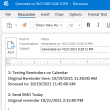
I’m seeing a lot of questions like this: “After a meeting request was created and sent to all our attendees, I want to add notes to that meeting on my calendar but I don't want other attendees to get the note I am saving. In Outlook 2003, it was a breeze. It lets me save the note without forcing me to send update. How do I do it in Outlook 2007?”
Clicking the X to close the form should bring up a dialog which offers Save and send updates, Save and don't send updates, or Don't Save. If it only offers Save and Send updates or Don't Save but keep open, use the following steps to save the changes to the meeting request without sending the update:
Open the meeting - it should have your notes saved (its never failed for me.) Yes, it is a roundabout way to do what should be a simple task, but it works. And yes, there is at least one bug in the process since it saves the changes anyway.
Another recent question involved changing a meeting time or date
without sending updates to attendees. While I have to wonder why
someone would change a meeting time or date and not want to
notify the attendees, it is possible - just remove the checkmark
from all names on the Scheduling assistant tab and make your
changes.
Outlook's limitation on Rules with Exchange
accounts receives a lot of complaints. If there
is not an Exchange account in the profile, a user
can have virtually unlimited rules, but Exchange
users are stuck with a paltry 32KB limitation.
(There is a practical limit as the Rules dialog
is not well suited for managing a large number of
rules and most people give up long before Outlook
complains.)
Prior versions stored client rules client-side and server rules on the server, but a change in the rules engine in Outlook 2002 moved all rules to the server if Exchange is in the profile, causing more users to hit the 32KB limit. This worked out to around 30 rules in Outlook 2002 but Outlook 2003 and 2007 switched to Unicode rules. Now each rule uses up more of that limited space, reducing the maximum number of rules to around 15, often fewer.
It is possible to reduce the size of the rules, allowing you to squeeze another rule or two into the 32KB. Along with deleting rules you no longer use, use short names for your rules. Renaming 'Rule to move mail from my wife and kids' to 'Family' saves space, as does shorter file names. If you are moving messages to a PST, move to the PST to a location with a short file path. Using "C:\Outlook\2008.pst" instead of "C:\Documents and Settings\username\Local Settings\Application Data\Microsoft\Outlook\everything i want to hide from my delegate.pst" will reduce the size of every rule using that PST.
See http://support.microsoft.com/kb/886616 for additional ways to squeeze more rules in.
If you're lucky enough to use Exchange 2007, the rules limit is higher - 64KB by default and configurable up to 256KB. This change will allow in the neighborhood of 100 rules, or about 90 more than I would want to manage in the Rules dialog.
Exchange 2007 users who need more
space for rules will need to ask their administrator
to raise their rules quota. If you're an
admin and don't know how to raise the rule quota, use
the following cmdlet in the Exchange management
shell to raise the limit to 256KB.
Set-Mailbox
username -RulesQuota:256KB
See http://technet.microsoft.com/en-us/library/bb123981(EXCHG.80).aspx for more information on Set-Mailbox commands. See Automatic Message Processing Tools for rules utilities, including the Incoming Mail Organizer and Sent Items Organizer by Sperry Software.
A common problem among travelers is the inability to send email when they are away from home. They can receive email just fine when using any public network but can't send. I had quite a few users tell me that they tried everything, including reinstalling Office, to fix the problem. That's a lot of work for nothing.
This is not a problem with Outlook. It's with the ISP and how they have the SMTP server configured. In an effort to prevent spammers from using their servers, many ISPs only allow users connecting from inside the network to send mail. When someone attempts to connect to the SMTP server from outside the network, the connection is denied. Some ISPs don't use authentication inside the network but require it when outside the network, so you can try setting up outgoing authentication. If this fails, contact support and ask if there is an alternate port you can use. If not, create a Gmail account and use its SMTP server when you travel.
To change your SMTP setting, go to Tools, Accounts. Select the Account and click Change, then More settings, Outgoing server.
A reader asks: "When I compose a message it very
tiny and unreadable. I changed font to no avail,
even size 20 font is very small."
Check your zoom setting.
It's on the Format Text ribbon in Outlook 2007.
It's never happened to me so I can only
guess
the recent rash of "tiny text" complaints is
caused by errant moves of a mouse wheel.
August 2008 cumulative
daylight saving time (DST) update for Exchange
Server 2003 SP2
http://support.microsoft.com/?kbid=956398
The From field is not displayed correctly when
you use Outlook or Outlook Web Access to view a
message
http://support.microsoft.com/?kbid=950209
Older Exchange Articles that were updated this
week:
Cannot Create MAPI Profile in Outlook 2000 ,
Arabic Version
http://support.microsoft.com/?kbid=820499
Delivery and read receipts header language
http://support.microsoft.com/?kbid=820500
Mailbox default folders language
http://support.microsoft.com/?kbid=820501
Default Public folder localized names
http://support.microsoft.com/?kbid=820502
Arabic details and address templates in exchange
2000
http://support.microsoft.com/?kbid=820503
Cannot Create MAPI Profile in Exchange 5.5 with
Arabic client OS
http://support.microsoft.com/?kbid=820505
Arabic emails when send using a UTF8 Client
cannot be read in OWA 2000
http://support.microsoft.com/?kbid=820508
Exchange Server 2000 does not support Arabic
characters in the domain name
http://support.microsoft.com/?kbid=820518
How to customize the Arabic templates in Exchange
2000 Server.
http://support.microsoft.com/?kbid=820802
How to open Arabic OWA in Exchange 2003 Server
http://support.microsoft.com/?kbid=820804
Changing the code page of an e-mail in outlook
does not affect the subject characters
http://support.microsoft.com/?kbid=820810
How to set encoding for incoming and outgoing
messages for POP3 and IMAP4 for specific users
http://support.microsoft.com/?kbid=836588
How to set the proper encoding for outgoing and
incoming messages for POP3 and IMAP4.
http://support.microsoft.com/?kbid=836586
Howto configure the Exchange to receive internet
mail with Arabic Characters
http://support.microsoft.com/?kbid=822994
System locale of the exchange recovery and
original servers should be matched
http://support.microsoft.com/?kbid=820749
You cannot open an .msg
e-mail message file in Outlook 2007 if the file
contains many attachments or many recipients
http://support.microsoft.com/?kbid=952295
Description of the Outlook 2007 hotfix package:
April 28, 2008
http://support.microsoft.com/?kbid=951995
Hotfix for KB 952295
Older Outlook Articles that were updated this
week:
Cannot Create MAPI Profile in Outlook 2000,
Arabic Version
http://support.microsoft.com/?kbid=820499
Delivery and read receipts header language
http://support.microsoft.com/?kbid=820500
Mailbox default folders language
http://support.microsoft.com/?kbid=820501
Default Public folder localized names
http://support.microsoft.com/?kbid=820502
Arabic details and address templates in exchange
2000
http://support.microsoft.com/?kbid=820503
Changing the code page of an e-mail in outlook
does not affect the subject characters
http://support.microsoft.com/?kbid=820810
Arabic characters are converted to junk in
messages from the web messaging servers
http://support.microsoft.com/?kbid=820815
How to display Arabic characters correctly on
Outlook XP and restore folders default name.
http://support.microsoft.com/?kbid=884659
You might receive emails where fields and the
subject show as question marks:
http://support.microsoft.com/?kbid=884510
Memba Velodoc
Outlook Add-in
http://www.codeplex.com/velodocaddin
Memba Velodoc Outlook Add-in lets you send large
files directly from Outlook using a variety of
file transfer server platforms including Velodoc
Enterprise Edition, Velodoc XP Edition, FTP
servers, UNC file shares, Microsoft Background
Intelligent Transfer Service (BITS) servers and
Amazon S3.
Remote Out-of-Office for Exchange
http://www.pergenex.com/remoteoof/index.shtml
Remote Out-of-Office for Exchange in a
server-based application that allows users to
remotely manage Out of Office settings for other
users, or themselves without Outlook, or any
additional applications. Once users are
configured with permissions to control other
users Out-of-Office settings, managing another
user's Out-of-Office settings is as easy as
sending an email.
Message Pad for
Outlook
http://www.emercury.co.uk/message_pad.htm
Message Pad for Outlook replaces phone message
pads, Post-It Note or bits of paper for your
phone messages. Messages can be picked up
remotely using email enabled mobile devices.
Workgroup management to allow office groups to
maximize productivity (requires Microsoft
Exchange). Fully integrated with Outlook. Free
evaluation.
Taskline
http://www.taskline.com/default.asp
Taskline automatically schedules Outlook's task
list. With Taskline, you know when each of your
tasks is likely to start and finish, enabling you
to meet deadlines with confidence. Taskline can
also display tasks in Outlook's calendar.
Taskline adds the ability to schedule different
types of tasks to different time slots, for
example work tasks during the day and personal
tasks at evenings and weekends. Version 3.