• Outlook User
  • New Outlook app
  • Outlook.com
  • Outlook Mac
  • Outlook & iCloud
  • Developer
  • Microsoft 365 Admin
    • Common Problems
    • Microsoft 365
    • Outlook BCM
    • Utilities & Addins

What is the difference between Export and Archive?

Slipstick Systems

› Outlook › Archiving › What is the difference between Export and Archive?

Last reviewed on August 23, 2013     4 Comments

Can someone explain the difference between the Export and Archive functions in Outlook? I would like to save selected folders of emails to a file that is external to the primary PST file. I may want to reload them at some point in the future so that I can read them, reply to them, or whatever. I started the Export function and I see that I have the option of selecting a PST file as the output. Is that the way to go? I Export with the PST output option the same as Archive -- or at least does it create the same type of output file? I was afraid to try the Archive function until I know whether it will delete the emails and whether I can get them back, if I want to.

When you use Export, you create a copy of the items in a Personal Folder file (.pst). When you use Archive, you move the items to a .pst file. So… while Export copies the items you are exporting, Archive removes them from your current data file.

You would use Export to create a backup of your data, especially when you are not using a pst file, or to create a copy to use on another computer. Note: if you are using a .pst file you should copy it, not export, to create a backup. Use Export if you just need one folder (or a few), not the entire contents of the pst file. You'll also use Export with Outlook.com accounts, and to back up Calendar and Contacts when you have an IMAP account in Outlook 2013.
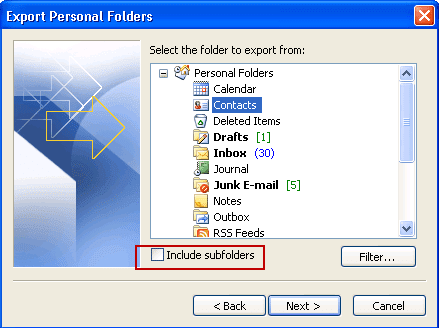
Use the export dialog to export a single folder

You'll use Archive when you want to remove older items from your active data file. You can also use it to delete Junk Mail and Deleted Items.
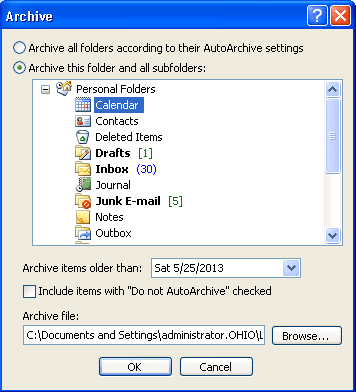
Use Archive to move items out of your data file

When you want to view the Archived items in Outlook, open the Archive file using File, Open, Outlook Data File, don't import the archive.


What is the difference between Export and Archive? was last modified: August 23rd, 2013 by Diane Poremsky

Related Posts:

  • How to Export Outlook Data to a PST File
  • How to use a batch (.bat) file to backup your Microsoft Outlook person
    Exporting to create a backup archive
  • How to back up Outlook's Rules and Alerts Rules
  • How to locate, read, or recover items archived using AutoArchive

About Diane Poremsky

A Microsoft Outlook Most Valuable Professional (MVP) since 1999, Diane is the author of several books, including Outlook 2013 Absolute Beginners Book. She also created video training CDs and online training classes for Microsoft Outlook. You can find her helping people online in Outlook Forums as well as in the Microsoft Answers and TechNet forums.

Subscribe
Notify of
4 Comments
newest
oldest most voted
Inline Feedbacks
View all comments

PhredE
June 5, 2023 12:10 pm

I seem to recall that Archive could be used for creating an empty .pst file for moving old emails to - archiving them. This was a technique a found on this site, I believe, but I can't find any trace.
The idea, I think, is to 'archive' all messages to a new .pst folder but with impossible criteria, ones that no messages will satisfy. That way, that archiving will create a duplicate file that's empty - except for the folder structure of the original.
Then a second archiving process can be done to populate it with old emails using a date criterion; the original .pst file will become 'half empty' and so can continue to be used, all Rules still working.
Now I'm wondering why the 'create empty structure' job would be necessary - probalby to create folders in the new file that don't receive any archives in the second run.

0
0
Reply
Diane Poremsky
Author
Reply to  PhredE
June 5, 2023 11:46 pm

You don't need to do it in a 2-step - the archive will create the folder structure. It should create all folders, even if nothing is being moved into it.

If you need an empty pst, but with the folder, the easiest is make a copy, then use search folders to find everything - select all, delete. Empty deleted items then compact the pst.

0
0
Reply
Marek Czerski
September 3, 2021 6:25 am

Thanks for your explanations, Diane – excellent, as always they are. I have not needed to use the archive function so far. Now, as my pst file has grown beyond a reasonable size I want to archive older mails that are stored in different folders in my pst. And in this context two questions:

1) My question is whether the archive function when moving mails to the archive pst file will recreate the folder stucture of mails moved in the archive file, or not? I have a "pst template", i.e. a pst file which has the same folder structure as my main pst, but there are no mails in it. I contemplated that I might use that template to be my archive pst file, but – will the archive funcition "find" the relevant folder to store each e-mail.

2) Whether, or not, I may direct Outllook to carry out and apply archiving proces to all mails from all the folders in my pst "at one shot", or I need to apply the function to each separate folder.

1
0
Reply
walter carroll
November 10, 2016 1:55 pm

If you want to archive files, the best thing to do is store them on a different volume, preferably a different hard drive. While you can put non Time Machine files on a Time Machine volume, you don't want to. If Time Machine gets corrupted, or you want to rebuild it, the best way to do it is to reinitialize the drive. You don't want to try to delete the files in a Time Machine archive - it would take hours and hours.

0
0
Reply

Visit Slipstick Forums.
What's New at Slipstick.com

Latest EMO: Vol. 30 Issue 38

Subscribe to Exchange Messaging Outlook


Support Services

Do you need help setting up Outlook, moving your email to a new computer, migrating or configuring Office 365, or just need some one-on-one assistance?

Our Sponsors

CompanionLink
ReliefJet
  • Popular
  • Latest
  • Week Month All
  • Use Classic Outlook, not New Outlook
  • How to Remove the Primary Account from Outlook
  • Reset the New Outlook Profile
  • Disable "Always ask before opening" Dialog
  • How to Hide or Delete Outlook's Default Folders
  • Removing Suggested Accounts in New Outlook
  • Change Outlook's Programmatic Access Options
  • Adjusting Outlook's Zoom Setting in Email
  • Move an Outlook Personal Folders .pst File
  • Classic Outlook is NOT Going Away in 2026
  • Opt out of Microsoft 365 Companion Apps
  • Mail Templates in Outlook for Windows (and Web)
  • Urban legend: Microsoft Deletes Old Outlook.com Messages
  • Buttons in the New Message Notifications
  • Move Deleted Items to Another Folder Automatically
  • Open Outlook Templates using PowerShell
  • Count and List Folders in Classic Outlook
  • Google Workspace and Outlook with POP Mail
  • Import EML Files into New Outlook
  • Opening PST files in New Outlook
Ajax spinner

Recent Bugs List

Microsoft keeps a running list of issues affecting recently released updates at Fixes or workarounds for recent issues in classic Outlook (Windows).

For new Outlook for Windows: Fixes or workarounds for recent issues in new Outlook for Windows .

Outlook for Mac Recent issues: Fixes or workarounds for recent issues in Outlook for Mac

Outlook.com Recent issues: Fixes or workarounds for recent issues on Outlook.com

Office Update History

Update history for supported Office versions is at Update history for Office

Outlook Suggestions and Feedback

Outlook Feedback covers Outlook as an email client, including Outlook Android, iOS, Mac, and Windows clients, as well as the browser extension (PWA) and Outlook on the web.

Outlook (new) Feedback. Use this for feedback and suggestions for Outlook (new).

Use Outlook.com Feedback for suggestions or feedback about Outlook.com accounts.

Other Microsoft 365 applications and services


New Outlook Articles

Opt out of Microsoft 365 Companion Apps

Mail Templates in Outlook for Windows (and Web)

Urban legend: Microsoft Deletes Old Outlook.com Messages

Buttons in the New Message Notifications

Move Deleted Items to Another Folder Automatically

Open Outlook Templates using PowerShell

Count and List Folders in Classic Outlook

Google Workspace and Outlook with POP Mail

Import EML Files into New Outlook

Opening PST files in New Outlook

Newest Code Samples

Open Outlook Templates using PowerShell

Count and List Folders in Classic Outlook

Insert Word Document into Email using VBA

Warn Before Deleting a Contact

Use PowerShell to Delete Attachments

Remove RE:, FWD:, and Other Prefixes from Subject Line

Change the Mailing Address Using PowerShell

Categorize @Mentioned Messages

Send an Email When You Open Outlook

Delete Old Calendar Events using VBA

Repair PST

Convert an OST to PST

Repair damaged PST file

Repair large PST File

Remove password from PST

Merge Two Data Files

Sync & Share Outlook Data

  • Share Calendar & Contacts
  • Synchronize two computers
  • Sync Calendar and Contacts Using Outlook.com
  • Sync Outlook & Android Devices
  • Sync Google Calendar with Outlook
  • Access Folders in Other Users Mailboxes

Diane Poremsky [Outlook MVP]

Make a donation

Mail Tools

Sending and Retrieval Tools

Mass Mail Tools

Compose Tools

Duplicate Remover Tools

Mail Tools for Outlook

Online Services

Calendar Tools

Schedule Management

Calendar Printing Tools

Calendar Reminder Tools

Calendar Dates & Data

Time and Billing Tools

Meeting Productivity Tools

Duplicate Remover Tools

Productivity

Productivity Tools

Automatic Message Processing Tools

Special Function Automatic Processing Tools

Housekeeping and Message Management

Task Tools

Project and Business Management Tools

Choosing the Folder to Save a Sent Message In

Run Rules on messages after reading

Help & Suggestions

Submit Outlook Feature Requests

Slipstick Support Services

Buy Microsoft 365 Office Software and Services

Visit Slipstick Forums.

What's New at Slipstick.com

Home | Outlook User | Exchange Administrator | Office 365 | Outlook.com | Outlook Developer
Outlook for Mac | Common Problems | Utilities & Addins | Tutorials
Outlook & iCloud Issues | Outlook Apps
EMO Archives | About Slipstick | Slipstick Forums
Submit New or Updated Outlook and Exchange Server Utilities

Send comments using our Feedback page
Copyright © 2026 Slipstick Systems. All rights reserved.
Slipstick Systems is not affiliated with Microsoft Corporation.

:wpds_smile::wpds_grin::wpds_wink::wpds_mrgreen::wpds_neutral::wpds_twisted::wpds_arrow::wpds_shock::wpds_unamused::wpds_cool::wpds_evil::wpds_oops::wpds_razz::wpds_roll::wpds_cry::wpds_eek::wpds_lol::wpds_mad::wpds_sad::wpds_exclamation::wpds_question::wpds_idea::wpds_hmm::wpds_beg::wpds_whew::wpds_chuckle::wpds_silly::wpds_envy::wpds_shutmouth:
wpDiscuz

Sign up for Exchange Messaging Outlook

Our weekly Outlook & Exchange newsletter (bi-weekly during the summer)


Please note: If you subscribed to Exchange Messaging Outlook before August 2019, please re-subscribe.

Never see this message again.

You are going to send email to

Move Comment