Many users have Outlook configured to use a Personal Folders file (PST) rather than an Exchange server mailbox. While anyone using a POP3, IMAP, or SharePoint links must use a PST, many Exchange server users choose a PST for various reasons, most often because they have a very small mailbox quota. While PST usage with Exchange accounts is counter to many of the reasons for using Exchange server, many organizations continue to allow the use of PST files.
Now that Outlook 2010 is in public beta, or semi-public beta,
we'll have more in-depth articles in future issues but this week
I'll highlight some of the features I think everyone will like.
I really like what I see. Yes, there are bugs and things don't
always work correctly (and many icons are red dots), but that is
to be expected in a beta. The interface has a somewhat flat
design. I like it, but it may change some in later builds.
Outlook has a ribbon interface throughout, including in the main
window. For the most part, it does bring all commands and
options out in front but there will be a learning curve for
experienced users.
The bell is back! As many of you have noticed, Outlook 2007
dropped the reminder bell on the Day/Week/Month view. The
missing bell generated a lot of feedback and Microsoft added it
back.
A second feature which should make a lot of people happy is the
ability to "pin" events to dates. Yes, you will be able to
change time zones and the event will no longer span two days.
Other "yes, they listen" changes include All day events are
shown on the To-Do bar and the links in the navigation pane are
gone, hopefully for good. Note that hourly appointments will
still move when the time zone is changed.
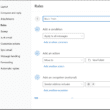
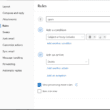
The Rules and Alerts dialog hasn't changed much, unfortunately,
so large numbers of rules will still be hard to manage, but Run
Rules Now is easier to access from the ribbon and there is a
Select All button in the Run Rules Now dialog.
A feature I'm happy to see is Quick Steps. These are rules
you'll use after the mail arrives. You can apply a quick step
either by clicking the button or with keyboard shortcuts
(Ctrl+Shift+1 through 9). I'm hoping Quick Steps will put an end
to the habit of filing messages in the Deleted Items folder.
I'm also glad to see that views have their own ribbon this makes
it much easier for users to find.
I think the new conversation view is great - it's gmail-like in
that replies and messages moved to other folders are included in
the thread in the message list. The conversation collapses to
one message (with the number of unread messages in parenthesis),
reducing the space the conversation uses in the Inbox. A 'clean
up' button removes redundant messages from the current folder
and puts them in a folder of your choice. The "close all items"
button is a favorite of mine - I have a habit of leaving a lot
of messages open and now I can close them all with one click.
In keeping with the "PST Management" theme this week, one final
comment: PST files now default to the My Documents folder and
the default filename is the email address. While this makes it
easier for home users to find and backup their data, it has the
potential to make things more difficult for administrators who
allow users to create PST files and use roaming profiles or
folder redirection. Note that SharePoint library PST files and
cached Exchange's OST files are stored under the user account in
\Local\Microsoft\Outlook\, only PST associated with accounts or
created by the end user are stored in the My documents folder.
We get too many questions from users and administrators who are accessing PST files over the network or who want to. This is not recommended and is not supported by Microsoft. While there are many things we do that are "not supported by Microsoft", in this case data loss can result.
An administrator had this question about the use of Distributed File System and PST: "We are implementing DFS and want to reduce the file lock on PST’s. All users connect via Citrix. I have seen reference the following reg key "PSTDisconnectDelay” to alter the timeout value on the file lock. However, I can not find the \pst reg key on any server. Should the key be there already?"
Since network use is not recommended, what storage media,
besides the local hard drive, is safe to use for PST files?
Floppy disks are not PST-friendly; fortunately very few people
use floppy disks anymore. Their read/write speed is too slow for
Outlook (and many other applications), leading to many corrupt
and unrecoverable files.
Is there any way to recover an .ost file that was orphaned after an exchange server was decommissioned?
If you use Outlook 2002 or earlier or are using a PST created in Outlook 2002 or older, you are using an ANSI format PST. This has a limitation of 2 GB. Outlook 2003 and 2007 support Unicode format, with a PST size of 20 GB by default. They support up to 33 TB, which may be practical some day. When you upgrade to Outlook 2003/2007, you need to make new PST files, Outlook will not upgrade a PST to the new format.
Description of the Outlook
2007 Junk E-mail Filter update: July 09, 2009
http://support.microsoft.com/?kbid=971933
Description of the Outlook 2003 Junk E-mail
Filter update: July 09, 2009
http://support.microsoft.com/?kbid=971931
Outlook 2007: You are unexpectedly prompted to
upgrade your .ost file to Unicode mode when you
start Outlook
http://support.microsoft.com/?kbid=2000633
Outlook 2007: How to block the export of entries
from the Global Address List (GAL) using group
policy
http://support.microsoft.com/?kbid=2000634
Outlook: BCC field is not displayed on some items
in the Sent Items folder
http://support.microsoft.com/?kbid=2000439
When inserting .jpeg images from SharePoint 2007
to Outlook 2003 you are being prompted for
network password
http://support.microsoft.com/?kbid=2000611
Office 2010 blog
http://blogs.technet.com/office2010/