Exchange Messaging Outlook
Volume 12, Number 6

Issue Date June 21 2007


Today's highlights:

Regular features:


Exchange 2007 Message Transport Rules

In Exchange 2000 Server and Exchange Server 2003 it was challenging to manipulate e-mail messages as they were routed through the organization or as they passed through the gateway to and from the internet. In those versions, SMTP was managed by an extended implementation of IIS SMTP. Controlling SMTP messages in simple ways, such as archiving, appending a disclaimer or implementing a catch-all mailbox, required coding (or borrowing code) SMTP Transport event sinks and registering them on the appropriate servers. While some functionality could be attained with VBScript, many sinks required Visual Basic, C# or C++ to meet the goals of the administrator. Exchange 2007 reverts to a proprietary SMTP implementation that exposes some basic message control during routing using a mechanism called Exchange 2007 Message Transport Rules.

Hub Transport Role versus Edge Transport Role
There is a slightly different scope and interface available for managing Transport Rules on the two roles that support them. Transport Rules administered at the hub transport server role are stored in the Exchange configuration container in Active Directory. Hub Transport Rules are centrally configured at the organization level. Transport Rules configured at the Edge Transport role are local to the Edge server, stored in ADAM. Hub Transport Rules are typically focused on compliance; whereas, Edge rules are often concerned with message hygiene.

Creating and Administering Transport Rules
The GUI for managing Transport Rules exists within the Exchange Management Console (EMC) and really resembles the Outlook Rules Wizard making it rather easy to learn. On a Hub Transport server, there is a Transport Rules tab in the Hub Transport properties of the Exchange Organization folder, as shown in Figure 1. This basic scenario shows 3 Transport Rules. The same 3 rules are visible through the Exchange Management Shell seen in Figure 2.


Figure 1
 

Figure 2


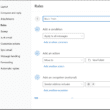
Creating a rule through the EMC is very simple. Like the Outlook Rules Wizard, message Transport Rules follow a logical creation path. If certain conditions are present in the message, then perform specific actions unless certain exceptions apply. Figure 3 shows an example of subject line manipulation based on a sender domain.
Exchange Management Shell also has many Cmdlets for administering Transport Rules. The ‘action’ portion of the commands are self-explanatory:
  • Get-TransportRule
  • Set-TransportRule
  • New-TransportRule
  • Enable-TransportRule
  • Disable-TransportRule
  • Remove-TransportRule
Transport Rules can also be exported to XML and imported from the command line. More information on composing proper Exchange Management Shell cmdlets for Transport Rules can be found in Technet at http://technet.microsoft.com/en-us/library/bb125136.aspx.


Figure 3

Other Features
Rules can be based on a number of items, including internal versus external messages, header items, message body content, and sender or recipient information. The Hub Transport Rulesets are very valuable for compliance. All messages must go through a hub transport server, and therefore all messages can have rules applied to them. As such, administrators can maintain solid control of messages for archiving or establishing ethical walls internally (for example, the accounting personnel may be prohibited from emailing the plant workers or vice versa). There is a limit of 1000 Transport Rules in an Exchange organization; however, this limitation is simply the threshold Microsoft tested up to and therefore supports.

Message Transport Rules are one of the most relevant areas of improvement for Exchange Server 2007. Tasks that were daunting in previous versions, yet menial in competing products, now have a quality solution with multiple interfaces and granular control.

-- William Lefkovics

A Bad Add-in with No Support

Ken Slovak, a well respected Outlook developer, discovered a problem with an Outlook toolbar add-in crashing Outlook and blaming the crash on other add-ins but the company who released the toolbar refuses to discuss it with him since he is not a registered user.

The problem is with an Outlook add-in called the Telephony Toolbar from Broadcom (http://info.onvoip.net/toolbar/) When the profile contains an Exchange account it crashes Outlook 2007 and any VB 6 add-in that handles Application and NameSpace events.

As soon as Outlook starts even a simple two line add-in in VB6 that does this:

Private WithEvents ol As Outlook.Application

' in OnConnection

Set ol = Application

The telephony toolbar causes a crash but the events and error dialogs place blame on other add-ins, not the toolbar. It came to Ken's attention because the combination of the telephony toolbar and Attachment Options caused a crash for a customer. He later discovered other problems: declaring NameSpace or Application WithEvents related to the toolbar add-in when running on any OS with Outlook 2007 with an Exchange account profile. The problems aren't limited to Ken's add-ins: as all good testers do, he tested it with several popular commercial Outlook add-ins and verified the crashes are not limited to his add-ins.

While we're hoping this VoIP add-in never gains wide usage, if you use it and have problems you'll know where the real problem lies.

Bug: Plain Text Spell Check

When you use Outlook 2007 and your default message format is plain text, beware of the spell check bug. When you use the option to always check the spelling on sending, corrections don't stick and the message is sent with the misspelled words.

If you use spell check as you type, corrections appear seem to stick. HTML message format is not affected.

Printing Problems in Outlook 2007

Outlook's printing abilities have always fell under the category of "leaves much to be desired" and Outlook 2007 shows little improvement. While Outlook does okay at printing emails (but could do better), contact images and business card views are not supported by the printer templates and calendar printing capabilities seem to get worse with each version.

The printing bugs in Outlook 2007 include broken line wrapping in the calendar. Daily events and locations are truncated instead of wrapping to the next line, while multi-day events that extend into the next week print into the margin at the end of the first week instead of wrapping into the next week.

Fortunately there is a workaround: the calendar printing assistant. It offers a number of templates and customizations, wraps lines as expected, and uses the traditional last month and next month thumbnail calendars.

Calendar Printing Assistant for Microsoft Office Outlook 2007
http://office.microsoft.com/en-us/outlook/HA101687211033.aspx

Printing Hints

Calendar:

You'll have better options if you use a Word template to create the calendar. You can add clip art and background colors before printing or save it as HTML and email the document to others. The templates use last month and next month thumbnail calendars. The Calendar Printing assistant for Outlook 2007 also uses last month and next month for the small calendars.

Contacts:
Contact pictures are not included in printouts.

Email:
While you can't change the layout to avoid the user name in large letters at the top of the printout, if you use Word as the editor with Outlook 2003 or previous, you can hit forward then Print and you'll get just the To/From/Date/Subject header. Close the forward when finished. This doesn't work in Outlook 2007. You can open HTML messages in the browser to print, although this method removes both the username and the email header.

When you want to print just part of an email message, you can use the same methods above: print after hitting Forward if Word is the editor or view in Browser. You'll have the much better print dialog in Word or IE. Unfortunately, Outlook 2007 doesn't use Word's better print engine, it sticks with the old Outlook print engine.

Attachment names aren't included in the printouts in all versions of Outlook. If you need the attachment name and your version doesn't support it switch the message format to RTF. (Open the message, Edit, Edit message menu then change the format.)

If these workarounds don't meet your needs, there are Word templates and other printing tools available, including two commercial add-ins offering many print options.

Blueprint for Outlook
http://www.savvisoft.com/ 

Outlook Printer
http://www.outlookprinter.com/

Calendar Printing Tools for Outlook
http://www.slipstick.com/addins/calendar_print.asp

Ordering Category Colors

An Outlook 2007 user asks: "When I label an event with multiple categories, I would like to choose which category color the event takes on the day/week/month view. For instance, I have an event, two categories, Category A and Category B, each with different colors, but I would like to have the event in the view take the color of Category B, not Category A. "

Items in Outlook 2007 use the color of the last category you apply, so select Category B last.
Back to Top  

New Utilities

C2OutlookExport
http://www.codetwo.eu/pages/freeware/outlook_export.php
C2OutlookExport is an easy to use free tool for exporting data from Microsoft Outlook to CSV text files. It can export much more data, than build-in export functionality in Outlook. It allows also for exporting user-defined properties from Outlook items, it is faster and easier to use. The program supports data export from all types of folders: Contact, Calendar, E-mail, Post, Task, Journal, Notes.

Category Organizer
http://www.software-solutions.co.nz/aladdins_co/alcoabout.asp
Category Organizer adds a sidebar to Outlook allowing instant access to your categories. Select a contact and instantly see the categories assigned, need to make changes, easy just use the checkboxes. Set filters to show only the items in specific categories.

CodeTwo Attach Unblocker
http://www.codetwo.eu/pages/freeware/attach_unblocker.php
Use CodeTwo Attach Unblocker to configure Microsoft Outlook to allow the opening of the attachments blocked by default (for example, .exe, .url, .reg). The program is an Outlook extension; its settings are available at the property sheet in the Outlook options, which ensures quick and convenient editing.

Exporter for Outlook
http://e-gadgets.freehostia.com/addins.htm
Exporter for Outlook extracts and saves messages (and attachments) from Outlook mailfolders to text files, in raw or RFC822 format, and to standard UNIX-type mailboxes (RFC822 format). Version 1.1

Ninja Disclaimers
http://www.sunbelt-software.com/Business/Ninja-Disclaimers/
A plug-in for Ninja Email Security, Ninja disclaimer provides includes global and user-based disclaimers for all outbound email for Exchange 2000 and 2003. Administrators have the ability to configure policy-based disclaimers based on specific users, groups, domains, or public folders. User-based disclaimers enable users to adjust their disclaimer statements according to a specific user or department. Ninja also prevents multiple disclaimers when replying or forwarding and gives administrators the ability to allow users to bypass the disclaimer on a per email basis. Disclaimer templates are included to allow easy set up of disclaimers using HTML or plain text. Template samples include legal disclaimers, virus warning disclaimers, copyright disclaimers, and more. New reports are also available that provide detailed information on the use of disclaimers within the organization.

Outlook Attachment Remover Add-in
http://www.kopf.com.br/outlook/
Free Outlook add-in for saving and extracting attachments, decreasing the size of your Outlook files.

Outlook Printer
http://www.outlookprinter.com/
Print your Outlook Emails the way you want. Outlook Printer allows you ro customize the printing of your Outlook mails with an easy to use interface. Prints incoming e-mails automatically.

PST Creator
http://www.programmers.com/ppi_us/Product.aspx?Sku=DD1%200000
PST Creator a programming add in which allows you to create PST files on the fly and hook them into your profile. It will also allow you to copy profiles and work with them. Features include the ability to copy an existing profile to another, remove profile information, create PST files as needed, and attach or remove PST files from profiles.

Softalk Share Server
http://www.softalkltd.com/products/softalkshareserver/
Softalk Share Server is an alternative to the collaboration features of Exchange. It provides sharing of private and public folders in Outlook, with full access control. Softalk Share Server works in a similar fashion to Exchange Server. There is no synchronization involved. All versions of Outlook supported from Outlook 2000 through 2007.

Back to Top  

Updated Utilities

Genie Outlook Backup
http://www.genie-soft.com/products/olb/default.html
Backup utility for Outlook 2000, 2002, 2003 handling folder data and key user options, including toolbar and Outlook bar settings, signatures, stationery, and Internet account information. Version 6.

MAPIViewer
http://www.daveswebsite.com/software/mapiviewer/
MAPIViewer is a free simple to use Windows NT/2000/XP utility that provides an Explorer-like interface for browsing MAPI stores accessible via the win32 MAPI API's, including MAPI stores, folders, and message item properties, and hierarchy.

NNTP for Outlook
http://slipstick.com/redirect.asp?id=nntp
Fully-functional NNTP transport for the MAPI subsystem. Use it with Outlook 2000 (Corporate/Workgroup mode) and Outlook 2002/2003/2007 to read and post to UseNet servers. Provides support of MIME, RTF and HTML. Features include dial-up support and an articles cache to optimize the downloading from several accounts. Version 1.5. Supports Outlook 2007.

OutBack Plus
http://www.ajsystems.com/obp.html
Backup your Outlook Personal Folders (.pst files) in a compressed, zip compatible, archive for a smaller and more easily managed file. All of your critical Outlook control files are included in the backup - Signatures, Stationery, Wizard Rules, etc are preserved for easy recovery. OutBack Plus allows you to restore the backup data to the same or another machine. Automatic reminder to backup after a set number of days. Also backs up Documents and Desktop folders, Internet Explorer Favorites, Cookies, offline folders and Firefox Browser data. Works with Outlook 2007, 2003, 2002 (XP), 2000, and 98, on Windows Vista, XP, Media Center, 2003, Windows 2000, Windows ME, and Windows 98. Version 6.

OutSource-XP
http://www.totalidea.com/content/index.html
OutSource-XP automatically collects all important Outlook 2002/2003 files and lists them so you can choose the files (and settings) you want to backup. The unregistered version of OutSource-XP v2 saves the files into a pre-selected backup-folder, but does not compress the files. The registered version compresses the backup into one single file, and offers a Quick-Backup feature which creates a backup just with a single mouse-click. Version 2. Supports Outlook 2007.

Back to Top  

Other Resources

Support WebCast: Microsoft Office Outlook 2007 integration with Microsoft Windows SharePoint Services (WSS) version 3 Contact Lists and Document Libraries
http://support.microsoft.com/?kbid=939015

Support WebCast: Introduction to RSS in Microsoft Office Outlook 2007
http://support.microsoft.com/?kbid=939017

Support WebCast: Introduction to security features and changes in Microsoft Office Outlook 2007
http://support.microsoft.com/?kbid=939016
Back to Top  

NNew Exchange Knowledge Base Articles

Database resources are not brought online when you use a "HRESERestoreComplete" function to restore a cluster database programmatically in Exchange Server 2007
http://support.microsoft.com/?kbid=938442

POP3 and IMAP4 clients cannot connect to a server that is running Exchange Server 2007
http://support.microsoft.com/?kbid=937359
Back to Top  

New Outlook Knowledge Base Articles

Description of the Outlook 2007 hotfix package: June 11, 2007
http://support.microsoft.com/?kbid=938534

Description of the Outlook 2007 hotfix package: June 12, 2007
http://support.microsoft.com/?kbid=937494

FIX: A table in a report that is delivered by SQL Server 2005 Reporting Services with Service Pack 2 appears to be compressed when the report is opened in Outlook 2007
http://support.microsoft.com/?kbid=935399

No progress occurs in the "Installation Progress" dialog box when you install the 2007 Office system or a stand-alone 2007 Office product
http://support.microsoft.com/?kbid=937680

Description of the Outlook 2003 Junk E-mail Filter update: June 12, 2007
http://support.microsoft.com/?kbid=936030

Error message when you try to create an IMAP profile in Outlook 2003: "The IMAP store could not be created"
http://support.microsoft.com/?kbid=937761

A rule that is based on the "through the specified account" option in Outlook 2003 works for two e-mail accounts, even though you specify only one e-mail account
http://support.microsoft.com/?kbid=937762

Delivery status notifications are unexpectedly generated in your personal folders (.pst) file after you install security updates 925938 and 929969 for Outlook 2003
http://support.microsoft.com/?kbid=938104

The Mail icon is missing from Control Panel after you upgrade to Office 2003 by using a custom transform (.mst) file that contains an Office Profile Settings (.ops) file
http://support.microsoft.com/?kbid=937763
Back to Top  

More Information/h3>

ISSN 1523-7990
Copyright 1996-2006, Slipstick Systems and CDOLive LLC. All rights reserved.