• Outlook User
  • New Outlook app
  • Outlook.com
  • Outlook Mac
  • Outlook & iCloud
  • Developer
  • Microsoft 365 Admin
    • Common Problems
    • Microsoft 365
    • Outlook BCM
    • Utilities & Addins

Organizational Forms Library in Exchange 2010

Slipstick Systems

› Exchange Server › Exchange 2010 › Organizational Forms Library in Exchange 2010

Last reviewed on December 4, 2018     21 Comments

Use the following steps to add an Organizational Forms Library to Exchange 2010.

Create an Organizational Forms Library in Exchange 2013 or 2016, or Office 365

Step 1:
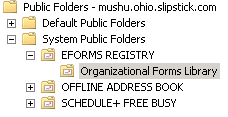
Exchange 2010 organizational forms library

Create a public folder named "Organizational Forms Library" under the EFORMS REGISTRY folders.

Use the New-PublicFolder cmdlet in the Exchange Management Shell to create the organizational forms library folder:

New-PublicFolder -Path "\NON_IPM_SUBTREE\EFORMS REGISTRY" -Name "Organizational Forms Library"

Or create the folder using Exchange Management Console > Toolbox > Public Folder Management.

Step 2:

Get ExFolder.exe, place it in the C:\Program Files\Microsoft\Exchange Server\V14\Bin folder. Run the reg file that is included in the exfolder.zip file before using ExFolder for the first time.

In ExFolders:

  1. File > Connect, select Public Folders.
  2. Select the Global Catalog server you want to use.
  3. Select the public folder database.
  4. Click OK and the public folder hierarchy will appear.
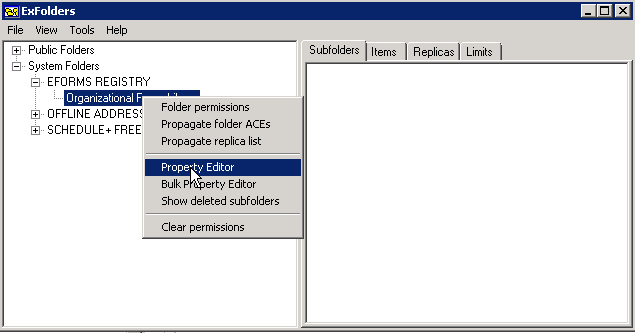
  5. Expand System Folders, EFORMS REGISTRY, right-click on the public folder you created for the organizational forms library, and then click Property Editor.
    Edit using ExFolder
  6. Go to Property > Add Property To View.
  7. In Add Property To View, enter 0x6707001E. Click OK.
  8. Find the PR_URL_NAME property you just added.
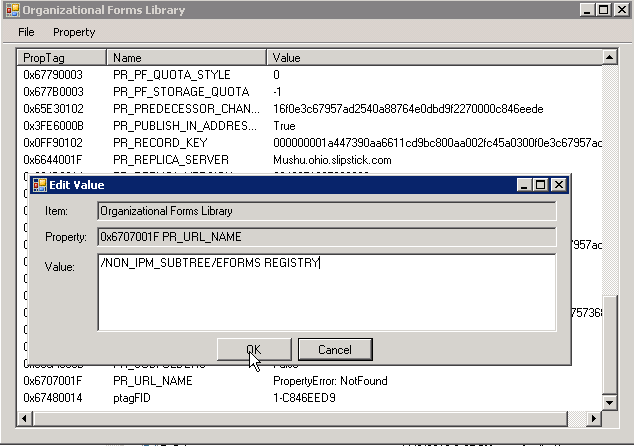
  9. Right-click on PR_URL_NAME and click Edit Value.
  10. Enter /NON_IPM_SUBTREE/EFORMS REGISTRY; click OK.
    Edit the PR_URL property
  11. Close ExFolders.

Step 3:

Download MFCMAPI on a computer that's running the 64-bit version of Outlook.

Note: these instructions were updated to use the January 2013 version of MFCMAPI.

  1. Open MFCMAPI. Go to Session > Logon and select your profile.
  2. Session menu > Advanced Logon > Display message store table.
  3. MDB menu > Public Folder > Open Public Folder Store, and then click OK to open the Public Folders window.
  4. Expand Public Root > NON_IPM_SUBTREE > EFORMS REGISTRY, select Organizational Forms Library.
  5. Find PR_URL_NAME in the Property column.
  6. Property menu > Additional Properties.
  7. In the Additional Properties dialog, click Add.
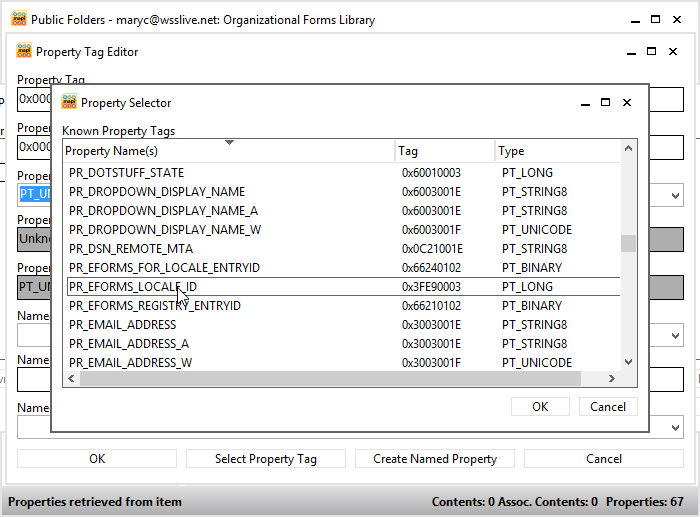
  8. In the Property Tag Editor, click Select Property Tag button.
  9. In Property Selector, click PR_EFORMS_LOCALE_ID, and then click OK.
    Select the property tag
  10. Click OK to close Property Tag Editor, then click OK to close Additional Properties.
  11. Locate the PR_EFORMS_LOCALE_ID property in the Property Name(s) column. (It has a red exclamation point (!) icon.)
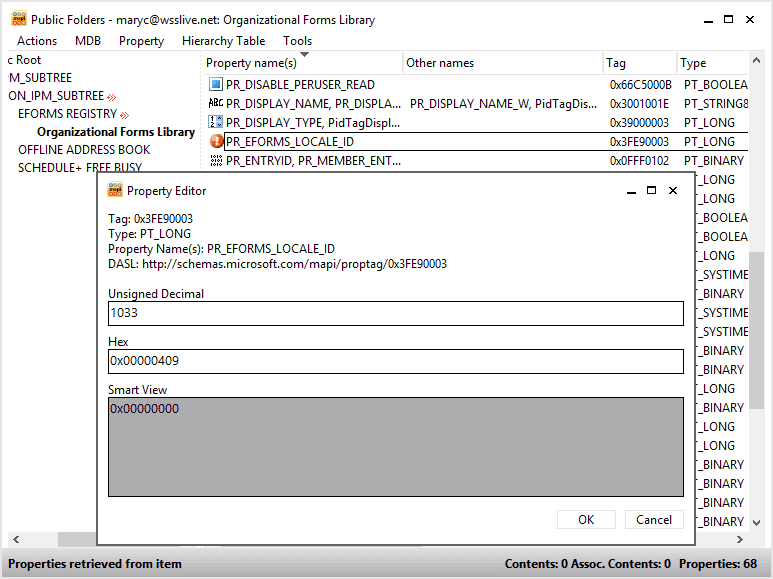
  12. Double-click PR_EFORMS_LOCALE_ID to open the Property Editor.
  13. In the Unsigned Decimal box, type the desired locale ID, and then click OK. (English = 1033)
    Edit the locale
  14. Close MFCMAPI.

The Organization Forms Library will now be listed in the Choose Form dialog. If users don't see it, they should restart Outlook.

Use or Publish forms

By default, users should have permission to the Organizational forms library, but if a user does not have permission to the folder, the administrator needs to give the person or group at least Read permission. This can be done using the Add-PublicFolderClientPermission cmdlet.

Add-PublicFolderClientPermission -identity "\NON_IPM_SUBTREE\EFORMS REGISTRY\Organizational Forms Library" -user maryc -AccessRights ReadItems

To publish custom forms to the Organizational forms library, the user needs CreateItems permission.

Add-PublicFolderClientPermission -identity "\NON_IPM_SUBTREE\EFORMS REGISTRY\Organizational Forms Library" -user maryc -AccessRights CreateItems

Outlook 2013 users will have access to the Organizational forms library but cannot publish to it.


Form Failed to Load error

Outlook 2010 and above caches the names of the forms in the Exchange Organizational Forms Library. The cache expires every 24 hours. If a new form in the Organizational Forms Library has not been cached, Outlook displays the error. The form is not cached in the Names File cache until the cache expires or times out.
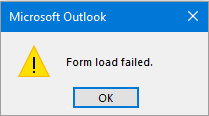
form load failed dialog

To eliminate the error, lower the timeout or disable it. If using Outlook 2013, change 14 to 15 or, for Outlook 2016, change 14 to 16.

HKEY_CURRENT_USER\Software\Microsoft\Office\14.0\Outlook\Forms\ClassNamesCache
 
DWORD: Timeout 
Decimal Value (in hours): 1 - 24

DWORD: Disabled 
Value: 1 

More Information

How to determine where to publish a custom Outlook form

Organizational Forms Library in Exchange 2010 was last modified: December 4th, 2018 by Diane Poremsky
Post Views: 7

Related Posts:

  • Create an Organizational Forms Library
  • Create an Organizational Forms Library in Exchange or Office 365
  • Publishing Custom Forms
  • Installing custom forms from the Microsoft Application farm isn't hard
    Publishing Microsoft Outlook "Application farm" Custom Forms

About Diane Poremsky

A Microsoft Outlook Most Valuable Professional (MVP) since 1999, Diane is the author of several books, including Outlook 2013 Absolute Beginners Book. She also created video training CDs and online training classes for Microsoft Outlook. You can find her helping people online in Outlook Forums as well as in the Microsoft Answers and TechNet forums.

Subscribe
Notify of
21 Comments
newest
oldest most voted
Inline Feedbacks
View all comments

Mike
September 14, 2016 11:33 pm

How can I make the form I have created, accessible in a public folder?

0
0
Reply
Diane Poremsky
Author
Reply to  Mike
September 15, 2016 7:11 am

Do you want it set as the default? If it's published to the org library, it can be used in any folder or you can publish it to the public folder (browse to find it) to use it just in that folder and set it to default, if necessary.
https://www.slipstick.com/developer/publishing-custom-forms/

0
0
Reply
yannik
July 12, 2016 2:34 am

Thank you for your help. My OFL is no almost up and running.
Strangely I cannot save any forms to the OFL even though my current user (on the computer and on Outlook) is an owner of the OFL folder. At least that's what my EMS tells me. As soon as I want to save my form I get the message form Outlook that I need to be an owner to the folder to save it.

Does anybody know what the issue might be?

0
0
Reply
Diane Poremsky
Author
Reply to  yannik
September 15, 2016 7:14 am

Sorry i missed this earlier. Did you resolve it? It should work - with 2 exceptions: there can be a delay in permissions propagating - allow up to 24 hours if the permissions were just changed. if not, there is an issue with outlook 2013/2016 saving directly to the org library - you need to save to personal folders and copy. That doesn't trigger an error message tho.

0
0
Reply
tisa
October 23, 2015 7:04 pm

Excellent post . I Appreciate the points - Does anyone know if my business would be able to find a blank 2012 UK VAF1A version to type on ?

0
0
Reply
Diane Poremsky
Author
Reply to  tisa
October 23, 2015 9:24 pm

I don't know, but maybe another reader does.

0
0
Reply
bran
November 13, 2013 4:45 am

Hi I have bit of a strange issue where I have a couple of users who cannot view the organisation form tab on there outlook profile. its seems to follow them over the network and any pc they login into. any ideas I've deleted profiles reinstalled office etc.

0
0
Reply
Diane Poremsky
Reply to  bran
November 13, 2013 7:28 pm

Did you check their permissions to the org library?

0
0
Reply
frank
November 4, 2013 8:29 am

Alright, I think i figured it out... At first i was trying to use Oulook 64 with MCFMAPI 64 on the exchange server itself and it result in subfolders disapeering after 5-6 seconde. Then i tried with a PC with Outlook 64 and it result with a MAPI_E_CALL_FAILED. The same happen with Outlook 32 and MCFMAPI 32. Note that both were using an account that has domain admin, Public Folder Management and Organization Management rights.
Turn out that I added that account to the permission of the "Organizational Forms Library" folder and set it to OWNER from the EMC and it worked this time but it didn't change the fact that is not working directly from the Exchange server itself.... Hope this can help someone
Thank you

0
0
Reply
James
Reply to  frank
July 6, 2016 2:01 pm

Thank you. This fixed the issue I was having.

0
-1
Reply
Frank
November 4, 2013 8:16 am

It's an Exchange profiles... I have try on another system with MCFMAPI 64 bit and Outlook 64 bit. I'm able to get to the last step but when I press here is the error:
I have tried also 32-BIT MCFMAPI and 32-BIT Outlook, same error.

Problem array:
Index: 0x00000000, ulPropTag: Tag: 0x3FE90003
Type: PT_LONG
Property Name(s): PR_EFORMS_LOCALE_ID
DASL: , scode: 0x80004005 = MAPI_E_CALL_FAILED

In file PropertyEditor.cpp
On line 720

0
0
Reply
frank
November 1, 2013 10:18 am

Not working for me..., MFCMAPI will display the subfolders of NON_IPM_SUBTREE for about 10 second then after they are gone... I have Outlook 64-bit with MFCMAPI 64-bit. what is going on!??

0
0
Reply
Diane Poremsky
Reply to  frank
November 1, 2013 9:17 pm

what type of email account is it? I'll try to repro.

0
0
Reply
Oliver
October 27, 2013 11:43 pm

Yes for the moment I always try with my own address and get an empty message. The form is published in my "Personal Forms Library".

I have no idea why the message is empty. I also don't use a seperate read layout.

0
0
Reply

Visit Slipstick Forums.
What's New at Slipstick.com

Latest EMO: Vol. 31 Issue 3

Subscribe to Exchange Messaging Outlook


Support Services

Do you need help setting up Outlook, moving your email to a new computer, migrating or configuring Office 365, or just need some one-on-one assistance?

Our Sponsors

CompanionLink
ReliefJet
  • Popular
  • Latest
  • Week Month All
  • Use Classic Outlook, not New Outlook
  • How to Remove the Primary Account from Outlook
  • Disable "Always ask before opening" Dialog
  • Reset the New Outlook Profile
  • How to Hide or Delete Outlook's Default Folders
  • This operation has been cancelled due to restrictions
  • Adjusting Outlook's Zoom Setting in Email
  • Mail Templates in Outlook for Windows (and Web)
  • Removing Suggested Accounts in New Outlook
  • Remove a password from an Outlook *.pst File
  • Error Opening iCloud Appointments in Classic Outlook
  • Opt out of Microsoft 365 Companion Apps
  • Mail Templates in Outlook for Windows (and Web)
  • Urban legend: Microsoft Deletes Old Outlook.com Messages
  • Buttons in the New Message Notifications
  • Move Deleted Items to Another Folder Automatically
  • Open Outlook Templates using PowerShell
  • Count and List Folders in Classic Outlook
  • Google Workspace and Outlook with POP Mail
  • Import EML Files into New Outlook
Ajax spinner

Recent Bugs List

Microsoft keeps a running list of issues affecting recently released updates at Fixes or workarounds for recent issues in classic Outlook (Windows).

For new Outlook for Windows: Fixes or workarounds for recent issues in new Outlook for Windows .

Outlook for Mac Recent issues: Fixes or workarounds for recent issues in Outlook for Mac

Outlook.com Recent issues: Fixes or workarounds for recent issues on Outlook.com

Office Update History

Update history for supported Office versions is at Update history for Office

Outlook Suggestions and Feedback

Outlook Feedback covers Outlook as an email client, including Outlook Android, iOS, Mac, and Windows clients, as well as the browser extension (PWA) and Outlook on the web.

Outlook (new) Feedback. Use this for feedback and suggestions for Outlook (new).

Use Outlook.com Feedback for suggestions or feedback about Outlook.com accounts.

Other Microsoft 365 applications and services


New Outlook Articles

Error Opening iCloud Appointments in Classic Outlook

Opt out of Microsoft 365 Companion Apps

Mail Templates in Outlook for Windows (and Web)

Urban legend: Microsoft Deletes Old Outlook.com Messages

Buttons in the New Message Notifications

Move Deleted Items to Another Folder Automatically

Open Outlook Templates using PowerShell

Count and List Folders in Classic Outlook

Google Workspace and Outlook with POP Mail

Import EML Files into New Outlook

Newest Code Samples

Open Outlook Templates using PowerShell

Count and List Folders in Classic Outlook

Insert Word Document into Email using VBA

Warn Before Deleting a Contact

Use PowerShell to Delete Attachments

Remove RE:, FWD:, and Other Prefixes from Subject Line

Change the Mailing Address Using PowerShell

Categorize @Mentioned Messages

Send an Email When You Open Outlook

Delete Old Calendar Events using VBA

Repair PST

Convert an OST to PST

Repair damaged PST file

Repair large PST File

Remove password from PST

Merge Two Data Files

Sync & Share Outlook Data

  • Share Calendar & Contacts
  • Synchronize two computers
  • Sync Calendar and Contacts Using Outlook.com
  • Sync Outlook & Android Devices
  • Sync Google Calendar with Outlook
  • Access Folders in Other Users Mailboxes

Diane Poremsky [Outlook MVP]

Make a donation

Mail Tools

Sending and Retrieval Tools

Mass Mail Tools

Compose Tools

Duplicate Remover Tools

Mail Tools for Outlook

Online Services

Calendar Tools

Schedule Management

Calendar Printing Tools

Calendar Reminder Tools

Calendar Dates & Data

Time and Billing Tools

Meeting Productivity Tools

Duplicate Remover Tools

Productivity

Productivity Tools

Automatic Message Processing Tools

Special Function Automatic Processing Tools

Housekeeping and Message Management

Task Tools

Project and Business Management Tools

Choosing the Folder to Save a Sent Message In

Run Rules on messages after reading

Help & Suggestions

Submit Outlook Feature Requests

Slipstick Support Services

Buy Microsoft 365 Office Software and Services

Visit Slipstick Forums.

What's New at Slipstick.com

Home | Outlook User | Exchange Administrator | Office 365 | Outlook.com | Outlook Developer
Outlook for Mac | Common Problems | Utilities & Addins | Tutorials
Outlook & iCloud Issues | Outlook Apps
EMO Archives | About Slipstick | Slipstick Forums
Submit New or Updated Outlook and Exchange Server Utilities

Send comments using our Feedback page
Copyright © 2026 Slipstick Systems. All rights reserved.
Slipstick Systems is not affiliated with Microsoft Corporation.

:wpds_smile::wpds_grin::wpds_wink::wpds_mrgreen::wpds_neutral::wpds_twisted::wpds_arrow::wpds_shock::wpds_unamused::wpds_cool::wpds_evil::wpds_oops::wpds_razz::wpds_roll::wpds_cry::wpds_eek::wpds_lol::wpds_mad::wpds_sad::wpds_exclamation::wpds_question::wpds_idea::wpds_hmm::wpds_beg::wpds_whew::wpds_chuckle::wpds_silly::wpds_envy::wpds_shutmouth:
wpDiscuz

Sign up for Exchange Messaging Outlook

Our weekly Outlook & Exchange newsletter (bi-weekly during the summer)


Please note: If you subscribed to Exchange Messaging Outlook before August 2019, please re-subscribe.

Never see this message again.

You are going to send email to

Move Comment