• Outlook User
  • New Outlook app
  • Outlook.com
  • Outlook Mac
  • Outlook & iCloud
  • Developer
  • Microsoft 365 Admin
    • Common Problems
    • Microsoft 365
    • Outlook BCM
    • Utilities & Addins

Where is the Organizer?

Slipstick Systems

› Outlook › Where is the Organizer?

Last reviewed on January 15, 2019     17 Comments

Applies to: Outlook (classic), Outlook 2010

Previous versions of Outlook each offered an Organize pane which allowed users to quickly apply colors to messages from specific users.

This is Outlook 2007's Organize pane:
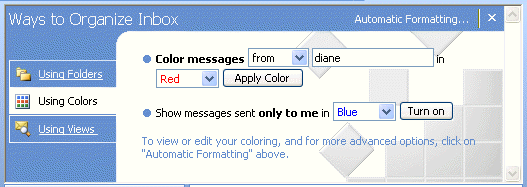
Organizer pane

The Organize pane was removed from Outlook 2010 (and newer). Instead, users will need to create Conditional formatting rules in View Settings. While this is more work, especially for simple rules, I believe it will reduce confusion - many users had no idea that Organizer created Automatic formatting rules in the current view. When they changed views or moved items to other folders, the coloring was lost and they had no idea why. (Using the /Cleanviews switch will erase all custom views, including those created using Organize or Conditional formatting. )

Automatic formatting was renamed Conditional formatting in Outlook 2010 to better reflect what the feature does.

Create Conditional Formatting Rules in a View

To create Conditional formatting rules, you need to open the Advanced View Settings dialog. There are several ways to get to this dialog in Outlook 2010 and above, the easiest is to switch to the View tab, then click the View Settings button.
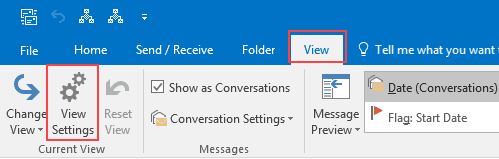
view settings

Now click the Conditional Formatting button, then click Add to create a formatting rule.
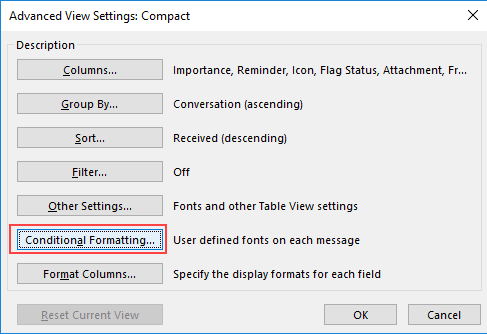
Advanced view Settings
Click Font to select a font and color then click Condition to set up the rule.
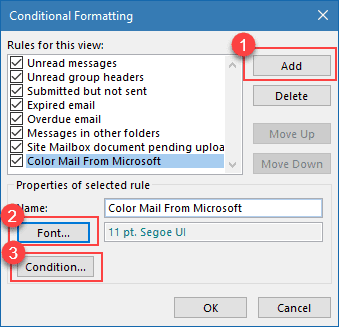
Create a conditional formatting rule

Video Tutorial

[wpvideo 7j02xN3G w=600]

Conditional Formatting Tips

To format all messages from a domain, add the domain name to the From field on the General tab. When you use the From field on the Advanced tab, Outlook looks at the Display name field, not the email address field.
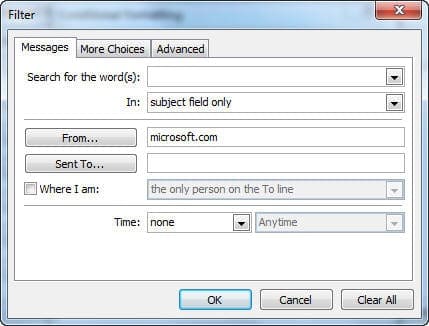
Create a conditional rule for all messages from a domain

Rules are tied together using the AND operator. A single rule such as From Mary OR To Mark is not possible unless you enable the QueryBuilder.

More Information

Using the QueryBuilder

Where is the Organizer? was last modified: January 15th, 2019 by Diane Poremsky
Post Views: 15

Related Posts:

  • Use Conditional Formatting to Highlight Messages
  • Conditional Formatting by Contact Category
  • How to color-code your email as it ages
  • Apply Conditional Formatting to Internal Email

About Diane Poremsky

A Microsoft Outlook Most Valuable Professional (MVP) since 1999, Diane is the author of several books, including Outlook 2013 Absolute Beginners Book. She also created video training CDs and online training classes for Microsoft Outlook. You can find her helping people online in Outlook Forums as well as in the Microsoft Answers and TechNet forums.

Comments

  1. Albert says

    February 9, 2017 at 2:33 pm

    how do you do this for outlook 2016?

    Reply
    • Diane Poremsky says

      February 9, 2017 at 3:00 pm

      It done the same way as Outlook 2010 - look on the View ribbon for View Settings, then conditional formatting.

      Reply
  2. Tommy Wendel says

    January 5, 2016 at 10:09 am

    I'm working since years with conditional formatting in my outlook calendar.
    I told it to my collegues and they all realized it in their outlook.
    AND NOW my boss want us to use it all (over 500 outlook users), with the settings that all meetings in all calendars are coloured in different colours for our different buildings: Meetings in building are green, in building two are blue and in building three are red.
    Is there a possibility to distribute the settings to ALL installations in our enterprise?
    btw: We work with Outlook 2010 and Exchange 2010.

    Reply
  3. Jeffrey Friedman says

    September 18, 2014 at 4:35 pm

    Very helpful solution BUT when I tried to add a new Conditioning Format the "Add" Button in Outlook 2010 was greyed out. Could this be because I had maxed out the number of colors applied when I was using the same mail box via Outlook 2007?

    How can I reactivate the Add button so that I can apply color via rules in Outlook 2010?

    Is there a limit in 2010 to the number of conditional formats you can have?

    Reply
    • Diane Poremsky says

      September 19, 2014 at 10:52 pm

      you could be at the max - do you have 27? That was the limit the last I knew. There should be an error messages that says you are at the max.
      https://www.outlook-tips.net/tips/tip-877-maximum-number-of-automatic-formatting-rules/

      Reply
  4. Jeanne Peacock says

    July 9, 2014 at 8:51 am

    I'm trying to color code some emails and trying to follow the instructions but when I get to Conditional Formatting it’s greyed out I can’t click on it. What can I do, not sure why it’s like that.

    Reply
    • Diane Poremsky says

      July 9, 2014 at 9:03 am

      Which version of Outlook and which view are you using? It should be available with any "list" or table style view, which is any view typically used for email. It's not available with some of the other formats (like icon, which is typically used for Notes, or timeline, which was used with the Journal.)

      Reply
  5. Ashraf Khundukji says

    October 29, 2013 at 11:26 am

    great tip and guide .. thanks

    Reply
  6. Joan Tedeschi says

    September 5, 2013 at 2:08 pm

    WOW...what a pain just to color code an individual name. 2007 was soooo easy.

    Reply
  7. Michele Swidowski says

    June 25, 2013 at 7:40 am

    Will the color coding of the email name change for previous emails or just after the conditional formatting is set.

    Reply
    • Diane Poremsky says

      June 25, 2013 at 7:42 am

      Conditional formatting is a view, so it applies to all messages in the folder. If you change views, the formatting is lost, if you look in other folders, the formatting is lost unless you apply the view to that folder.

      Reply
  8. Donna Gregory says

    February 28, 2013 at 8:14 am

    Thank you Diane! Your video was great! Task accomplished! :)

    Reply
  9. Keith says

    August 14, 2012 at 12:25 am

    I wanted to know who is the "organiser" of appointments taht mysteriously appear in my outlook calendar. As usual, help is useless unless you know the jargon the programmer is talking in.
    All I want to be able to do today is stop people putting items in my calendar without talking to me about them.

    Reply
    • Diane Poremsky says

      August 14, 2012 at 4:53 am

      That's a different organizer. :) Are they inviting you to meetings or opening your calendar and adding appointments? You can remove 'create' permissions from the people who abuse the feature.

      To see the person who created the appointments, you can use custom views. Use a list view and add the Organizer field (or From field) to the view. The basics of creating a custom view is here: Custom view tutorial. Actually, I forgot about this page: View the organizer.

      Reply
  10. MIchelle says

    April 15, 2012 at 11:53 pm

    WHy doesn't microsoft just reinstate the organizer?????????

    Reply
  11. Tia says

    February 1, 2012 at 3:42 pm

    All I would like to do is color code the names of incoming emails, for example all the emails from my teammates are in red, the ones from my principal are in purple, etc. How do i do that ?

    Reply
    • Diane Poremsky says

      February 1, 2012 at 4:24 pm

      You need to create a custom view with conditional formatting. Getting the teammates will be more difficult than single addresses - it might be easier to use rules to set a category ("Teammates") then apply formatting to mail in the Teammates category.

      Reply

Leave a Reply Cancel reply

Your email address will not be published. Required fields are marked *

Visit Slipstick Forums.
What's New at Slipstick.com

Latest EMO: Vol. 31 Issue 3

Subscribe to Exchange Messaging Outlook


Support Services

Do you need help setting up Outlook, moving your email to a new computer, migrating or configuring Office 365, or just need some one-on-one assistance?

Our Sponsors

CompanionLink
ReliefJet
  • Popular
  • Latest
  • Week Month All
  • Jetpack plugin with Stats module needs to be enabled.
  • Error Opening iCloud Appointments in Classic Outlook
  • Opt out of Microsoft 365 Companion Apps
  • Mail Templates in Outlook for Windows (and Web)
  • Urban legend: Microsoft Deletes Old Outlook.com Messages
  • Buttons in the New Message Notifications
  • Move Deleted Items to Another Folder Automatically
  • Open Outlook Templates using PowerShell
  • Count and List Folders in Classic Outlook
  • Google Workspace and Outlook with POP Mail
  • Import EML Files into New Outlook
Ajax spinner

Recent Bugs List

Microsoft keeps a running list of issues affecting recently released updates at Fixes or workarounds for recent issues in classic Outlook (Windows).

For new Outlook for Windows: Fixes or workarounds for recent issues in new Outlook for Windows .

Outlook for Mac Recent issues: Fixes or workarounds for recent issues in Outlook for Mac

Outlook.com Recent issues: Fixes or workarounds for recent issues on Outlook.com

Office Update History

Update history for supported Office versions is at Update history for Office

Outlook Suggestions and Feedback

Outlook Feedback covers Outlook as an email client, including Outlook Android, iOS, Mac, and Windows clients, as well as the browser extension (PWA) and Outlook on the web.

Outlook (new) Feedback. Use this for feedback and suggestions for Outlook (new).

Use Outlook.com Feedback for suggestions or feedback about Outlook.com accounts.

Other Microsoft 365 applications and services


New Outlook Articles

Error Opening iCloud Appointments in Classic Outlook

Opt out of Microsoft 365 Companion Apps

Mail Templates in Outlook for Windows (and Web)

Urban legend: Microsoft Deletes Old Outlook.com Messages

Buttons in the New Message Notifications

Move Deleted Items to Another Folder Automatically

Open Outlook Templates using PowerShell

Count and List Folders in Classic Outlook

Google Workspace and Outlook with POP Mail

Import EML Files into New Outlook

Newest Code Samples

Open Outlook Templates using PowerShell

Count and List Folders in Classic Outlook

Insert Word Document into Email using VBA

Warn Before Deleting a Contact

Use PowerShell to Delete Attachments

Remove RE:, FWD:, and Other Prefixes from Subject Line

Change the Mailing Address Using PowerShell

Categorize @Mentioned Messages

Send an Email When You Open Outlook

Delete Old Calendar Events using VBA

Repair PST

Convert an OST to PST

Repair damaged PST file

Repair large PST File

Remove password from PST

Merge Two Data Files

Sync & Share Outlook Data

  • Share Calendar & Contacts
  • Synchronize two computers
  • Sync Calendar and Contacts Using Outlook.com
  • Sync Outlook & Android Devices
  • Sync Google Calendar with Outlook
  • Access Folders in Other Users Mailboxes

Diane Poremsky [Outlook MVP]

Make a donation

Mail Tools

Sending and Retrieval Tools

Mass Mail Tools

Compose Tools

Duplicate Remover Tools

Mail Tools for Outlook

Online Services

Calendar Tools

Schedule Management

Calendar Printing Tools

Calendar Reminder Tools

Calendar Dates & Data

Time and Billing Tools

Meeting Productivity Tools

Duplicate Remover Tools

Productivity

Productivity Tools

Automatic Message Processing Tools

Special Function Automatic Processing Tools

Housekeeping and Message Management

Task Tools

Project and Business Management Tools

Choosing the Folder to Save a Sent Message In

Run Rules on messages after reading

Help & Suggestions

Submit Outlook Feature Requests

Slipstick Support Services

Buy Microsoft 365 Office Software and Services

Visit Slipstick Forums.

What's New at Slipstick.com

Home | Outlook User | Exchange Administrator | Office 365 | Outlook.com | Outlook Developer
Outlook for Mac | Common Problems | Utilities & Addins | Tutorials
Outlook & iCloud Issues | Outlook Apps
EMO Archives | About Slipstick | Slipstick Forums
Submit New or Updated Outlook and Exchange Server Utilities

Send comments using our Feedback page
Copyright © 2026 Slipstick Systems. All rights reserved.
Slipstick Systems is not affiliated with Microsoft Corporation.