• Outlook User
  • New Outlook app
  • Outlook.com
  • Outlook Mac
  • Outlook & iCloud
  • Developer
  • Microsoft 365 Admin
    • Common Problems
    • Microsoft 365
    • Outlook BCM
    • Utilities & Addins

Apply Outlook Stationery to Replies and Forwards

Slipstick Systems

› Outlook › Email › Apply Outlook Stationery to Replies and Forwards

Last reviewed on October 13, 2017     2 Comments

One question I'm often asked about stationery is how to apply it to replies and forwards. This is not possible using native Outlook features, as Outlook uses the same format for replies and forwards that was used in the original message.

However, you can use a macro to insert an HTML stationery file into replies, forwards, or even new messages you are composing. (You can also use this method to insert 'boilerplate' text files.)

You can insert stationery into a reply in the reading pane. The HTML file can include background colors and any images must be in the code using the full path to the image.
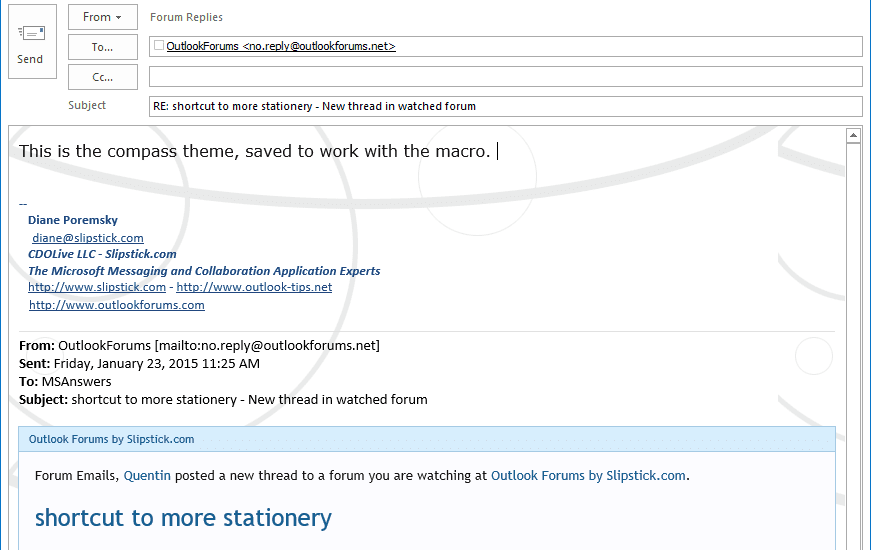
apply a theme to a message

Because the theme is inserted into the file, your cursor may be 'invisible' when you type. It eventually comes back but if you are in a hurry to see the flashing cursor, you can save and reopen the message.

This code uses the Scripting Runtime to read the HTML file. You'll need to set a reference to it in the VB Editor's Tools, References dialog.
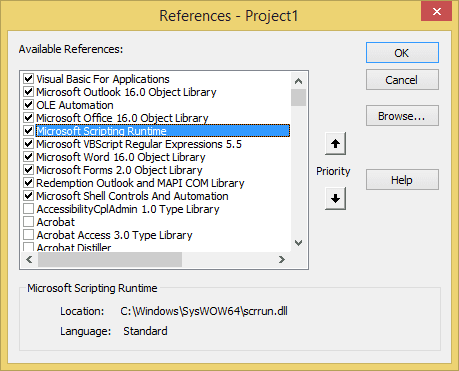
Set a reference to scripting runtime

Do you want to create new messages using a specific stationery without using the More Stationery dialog? See Insert an HTML file or Stationery into a New Message.

To use this macro, add the code to the VB Editor and edit the file name. Open a new message and create a button on the ribbon for this macro. When you want to use the stationery, click the button.

While you can set the stationery automatically when you click reply, the messages may be messy and difficult to read. If you want to automatically apply the stationery, VBA Sample: Do something when Reply is clicked shows how to 'do something'. You'll need to put it together with this code.

 Sub InsertStationery()
' You need to set a reference to the scripting object
 Dim fso As Scripting.FileSystemObject
 Dim tsTextIn As Scripting.TextStream
 Dim strTextIn As String
 Dim strInsert As String
 Dim fsoFile As Scripting.File
 Dim fsoFldr As Scripting.Folder
 Dim dtNew As Date, sNew As String
 
Dim enviro As String
enviro = CStr(Environ("USERPROFILE"))
' your stationery file
strFile = enviro & "\AppData\Roaming\Microsoft\Stationery\compass.htm"

 Set fso = New Scripting.FileSystemObject
 'read html
 Set tsTextIn = fso.OpenTextFile(strFile)
 strTextIn = tsTextIn.ReadAll

 'Use open e-mail item
 Set objMail = Application.ActiveInspector.CurrentItem

 With objMail
' copy the original message body
 strInsert = .HTMLBody
' add the stationery file
 .HTMLBody = strTextIn
'add the original message body back
 .HTMLBody = .HTMLBody & strInsert
 .Display
 End With
 
End Sub


Inline reply (Reading Pane)

You can insert stationery (or text files containing boilerplate text) into a reading pane reply using the following code. If the HTML file contains images, they need to be linked using the full path to the file, like this:
<body background="C:\path\to\image.gif" bgcolor="#C9B49A">
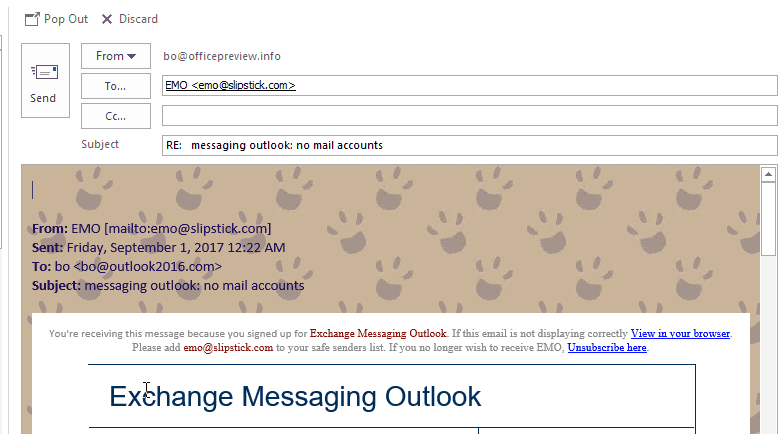
insert stationery using inline editor

This code goes in ThisOutlookSession.

Dim myOlApp As New Outlook.Application
Public WithEvents myOlExplorer As Outlook.Explorer

Public Sub Initialize_handler()
Set myOlExplorer = myOlApp.ActiveExplorer
End Sub

Private Sub myOlExplorer_InlineResponse(ByVal Item As Object)
' do things to the Item here in the inline response
 Dim fso As Scripting.FileSystemObject
 Dim tsTextIn As Scripting.TextStream
 Dim strTextIn As String
 Dim strInsert As String
 Dim fsoFile As Scripting.File
 Dim fsoFldr As Scripting.Folder

Dim enviro As String
enviro = CStr(Environ("USERPROFILE"))
' your stationery file
strFile = enviro & "\AppData\Roaming\Microsoft\Stationery\pawprint.htm"

 Set fso = New Scripting.FileSystemObject
 'read html
 Set tsTextIn = fso_OpenTextFile(StrFile)
 strTextIn = tsTextIn.ReadAll

Item.HTMLBody = strTextIn & Item.HTMLBody
End Sub

Outlook's Stationery and Theme Files

Office uses several locations for stationery files.

User-created HTML files that are listed in the More Stationery dialog list are stored at
C:\Users\username\AppData\Roaming\Microsoft\Stationery. You can open this folder by typing %appdata%\microsoft\stationery in the address bar of Windows Explorer and pressing Enter. You can copy your custom stationery to this location so it's accessible using the macro or using the Stationery picker.

Microsoft installs the default Stationery in these locations:

C:\Program Files\Common Files\microsoft shared\Stationery
C:\Program Files (x86)\Common Files\Microsoft Shared\Stationery
C:\Program Files (x86)\Microsoft Office\root\Stationery\

If you want to use one of the default stationeries with this macro, you'll need to edit the image filepath. I recommend copying the HTML file and background image to the user's stationery folder before editing the image filepath.

The More Stationery dialog box includes themes, which cannot be applied using VBA. (These themes are stored under the Office installation folder at \Microsoft Shared\THEMES*\. For example, in Office 2013 32-bit, the Compass theme is at C:\Program Files (x86)\Microsoft Office\root\VFS\ProgramFilesCommonX86\Microsoft Shared\THEMES15\COMPASS.)
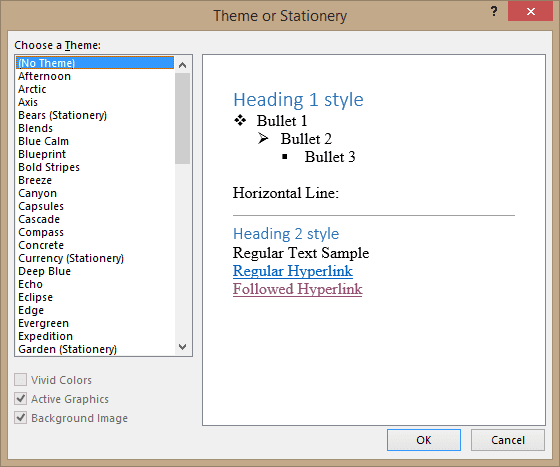
More Stationery picker

If you want to use one of the themes as your stationery, you'll need to create a new message and save it as HTML, then edit the HTML and enter the full path to the images in the HTML. Open the HTML file in Notepad then scroll to the bottom for the file. Change the filepath for the background and remove the xml code from the body tags, leaving code similar to this:

How to use macros

First: You will need macro security set to low during testing.

To check your macro security in Outlook 2010 or 2013, go to File, Options, Trust Center and open Trust Center Settings, and change the Macro Settings. In Outlook 2007 and older, it’s at Tools, Macro Security.

After you test the macro and see that it works, you can either leave macro security set to low or sign the macro.

Open the VBA Editor by pressing Alt+F11 on your keyboard.

To put the code in a module:

  1. Right click on Project1 and choose Insert > Module
  2. Copy and paste the macro into the new module.

More information as well as screenshots are at How to use the VBA Editor

More Information

Always Reply Using HTML Format in Outlook
VBA Sample: Do something when Reply is clicked

Apply Outlook Stationery to Replies and Forwards was last modified: October 13th, 2017 by Diane Poremsky

Related Posts:

  • Create a New Message using an HTML File or Stationery
  • Insert or change an Outlook signature using VBA
  • Use a Macro to Attach Files to New Messages
  • Can I use my own stationery in replies?

About Diane Poremsky

A Microsoft Outlook Most Valuable Professional (MVP) since 1999, Diane is the author of several books, including Outlook 2013 Absolute Beginners Book. She also created video training CDs and online training classes for Microsoft Outlook. You can find her helping people online in Outlook Forums as well as in the Microsoft Answers and TechNet forums.

Subscribe
Notify of
2 Comments
newest
oldest most voted
Inline Feedbacks
View all comments

Larry Marks
November 12, 2021 10:55 am

I tried this with Outlook 16--the background color did not show up--

0
0
Reply
Diane Poremsky
Author
Reply to  Larry Marks
November 13, 2021 12:26 am

This was a color, not an image? That could happen if the css is not embedded. I'll test it.

0
0
Reply

Visit Slipstick Forums.
What's New at Slipstick.com

Latest EMO: Vol. 30 Issue 36

Subscribe to Exchange Messaging Outlook


Support Services

Do you need help setting up Outlook, moving your email to a new computer, migrating or configuring Office 365, or just need some one-on-one assistance?

Our Sponsors

CompanionLink
ReliefJet
  • Popular
  • Latest
  • Week Month All
  • Use Classic Outlook, not New Outlook
  • How to Remove the Primary Account from Outlook
  • Reset the New Outlook Profile
  • This operation has been cancelled due to restrictions
  • Adjusting Outlook's Zoom Setting in Email
  • How to Hide or Delete Outlook's Default Folders
  • Disable "Always ask before opening" Dialog
  • Removing Suggested Accounts in New Outlook
  • Remove a password from an Outlook *.pst File
  • Syncing Outlook with an Android smartphone
  • Opt out of Microsoft 365 Companion Apps
  • Mail Templates in Outlook for Windows (and Web)
  • Urban legend: Microsoft Deletes Old Outlook.com Messages
  • Buttons in the New Message Notifications
  • Move Deleted Items to Another Folder Automatically
  • Open Outlook Templates using PowerShell
  • Count and List Folders in Classic Outlook
  • Google Workspace and Outlook with POP Mail
  • Import EML Files into New Outlook
  • Opening PST files in New Outlook
Ajax spinner

Recent Bugs List

Microsoft keeps a running list of issues affecting recently released updates at Fixes or workarounds for recent issues in classic Outlook (Windows).

For new Outlook for Windows: Fixes or workarounds for recent issues in new Outlook for Windows .

Outlook for Mac Recent issues: Fixes or workarounds for recent issues in Outlook for Mac

Outlook.com Recent issues: Fixes or workarounds for recent issues on Outlook.com

Office Update History

Update history for supported Office versions is at Update history for Office

Outlook Suggestions and Feedback

Outlook Feedback covers Outlook as an email client, including Outlook Android, iOS, Mac, and Windows clients, as well as the browser extension (PWA) and Outlook on the web.

Outlook (new) Feedback. Use this for feedback and suggestions for Outlook (new).

Use Outlook.com Feedback for suggestions or feedback about Outlook.com accounts.

Other Microsoft 365 applications and services


New Outlook Articles

Opt out of Microsoft 365 Companion Apps

Mail Templates in Outlook for Windows (and Web)

Urban legend: Microsoft Deletes Old Outlook.com Messages

Buttons in the New Message Notifications

Move Deleted Items to Another Folder Automatically

Open Outlook Templates using PowerShell

Count and List Folders in Classic Outlook

Google Workspace and Outlook with POP Mail

Import EML Files into New Outlook

Opening PST files in New Outlook

Newest Code Samples

Open Outlook Templates using PowerShell

Count and List Folders in Classic Outlook

Insert Word Document into Email using VBA

Warn Before Deleting a Contact

Use PowerShell to Delete Attachments

Remove RE:, FWD:, and Other Prefixes from Subject Line

Change the Mailing Address Using PowerShell

Categorize @Mentioned Messages

Send an Email When You Open Outlook

Delete Old Calendar Events using VBA

VBA Basics

How to use the VBA Editor

Work with open item or selected item

Working with All Items in a Folder or Selected Items

VBA and non-default Outlook Folders

Backup and save your Outlook VBA macros

Get text using Left, Right, Mid, Len, InStr

Using Arrays in Outlook macros

Use RegEx to extract message text

Paste clipboard contents

Windows Folder Picker

Custom Forms

Designing Microsoft Outlook Forms

Set a custom form as default

Developer Resources

Developer Resources

Developer Tools

VBOffice.net samples

SlovakTech.com

Outlook MVP David Lee

Repair PST

Convert an OST to PST

Repair damaged PST file

Repair large PST File

Remove password from PST

Merge Two Data Files

Sync & Share Outlook Data

  • Share Calendar & Contacts
  • Synchronize two computers
  • Sync Calendar and Contacts Using Outlook.com
  • Sync Outlook & Android Devices
  • Sync Google Calendar with Outlook
  • Access Folders in Other Users Mailboxes

Diane Poremsky [Outlook MVP]

Make a donation

Mail Tools

Sending and Retrieval Tools

Mass Mail Tools

Compose Tools

Duplicate Remover Tools

Mail Tools for Outlook

Online Services

Calendar Tools

Schedule Management

Calendar Printing Tools

Calendar Reminder Tools

Calendar Dates & Data

Time and Billing Tools

Meeting Productivity Tools

Duplicate Remover Tools

Productivity

Productivity Tools

Automatic Message Processing Tools

Special Function Automatic Processing Tools

Housekeeping and Message Management

Task Tools

Project and Business Management Tools

Choosing the Folder to Save a Sent Message In

Run Rules on messages after reading

Help & Suggestions

Submit Outlook Feature Requests

Slipstick Support Services

Buy Microsoft 365 Office Software and Services

Visit Slipstick Forums.

What's New at Slipstick.com

Home | Outlook User | Exchange Administrator | Office 365 | Outlook.com | Outlook Developer
Outlook for Mac | Common Problems | Utilities & Addins | Tutorials
Outlook & iCloud Issues | Outlook Apps
EMO Archives | About Slipstick | Slipstick Forums
Submit New or Updated Outlook and Exchange Server Utilities

Send comments using our Feedback page
Copyright © 2025 Slipstick Systems. All rights reserved.
Slipstick Systems is not affiliated with Microsoft Corporation.

:wpds_smile::wpds_grin::wpds_wink::wpds_mrgreen::wpds_neutral::wpds_twisted::wpds_arrow::wpds_shock::wpds_unamused::wpds_cool::wpds_evil::wpds_oops::wpds_razz::wpds_roll::wpds_cry::wpds_eek::wpds_lol::wpds_mad::wpds_sad::wpds_exclamation::wpds_question::wpds_idea::wpds_hmm::wpds_beg::wpds_whew::wpds_chuckle::wpds_silly::wpds_envy::wpds_shutmouth:
wpDiscuz

Sign up for Exchange Messaging Outlook

Our weekly Outlook & Exchange newsletter (bi-weekly during the summer)


Please note: If you subscribed to Exchange Messaging Outlook before August 2019, please re-subscribe.

Never see this message again.

You are going to send email to

Move Comment