We recently started to see problems that are
solved by uninstalling the July 13 update, which
also included the April 27 2010 hotfix along with
the security fixes. Apparently very few people
installed the hotfix - we saw no complaints until
late July.
The April update introduced line wrap to printed
Monthly calendars, as seen in older versions of
Outlook. Unfortunately, the algorithm that did
the wrapping didn't do a very good job and new
lines begin in the middle of words. Oops. The end
date was also removed. We've had a lot of
complaint about the lack of line wrapping since
the release of Outlook 2007, now they're
complaining about the lack of the end times.
These issues are scheduled to be addressed in
updates later this year.
Another problem that goes away when the update is uninstalled is "now you
see them, now you don't" Color categories. One of the affected users
described it like this: "I noticed that when I open Outlook 2007, often
times (but not all the time), my categories are reset to the default basic
colors. If I close Outlook and re-open it, they usually all come back! When
"missing", the names of the categories will show up with gray background in
appointments or contacts instead of whatever color they should be. When
"categories" list is viewed, none of these categories show up at all."
Because he described the problem as "just started" in the same time frame as the update, I suggested they trying uninstalling the update. Since doing so, the categories don't disappear.
We also saw a couple of problems with recurring appointments that were solved by removing this update, including one where the attachment wouldn't open.
If you notice any other weird or buggy behavior, try uninstalling the
update (and send us an email.)
While the update is a "critical security update", the exploit it addresses
is only triggered by a user opening an attachment that arrives in an email
message. Consider how likely someone would open an unknown attachment on the
computer when deciding whether you can go without it until the issue that
bugs you is fixed.
Note that automatic updates will keep installing the Update. You need to go
to the update site and hide this update. Uninstall the update, go to the
Start menu and click the link for Windows Update. Let it search for updates
it thinks you need then review the list. Right click on this update (and any
others you don't want offered) and mark it hidden.
MS10-045: Description of the security update for Outlook 2007: July 13, 2010
http://support.microsoft.com/kb/980376
Description of the Office Outlook 2007 hotfix package (outlook-x-none.msp):
April 27, 2010
http://support.microsoft.com/kb/981048
A user recently asked if he could customize the view in OWA, like he can in Outlook. He would like to be able to see the To and From fields in the view.
Unfortunately, you can't add fields in OWA. You'll need to use Arrange By - click on Arrange by bar and select TO. This will group your mails by the TO field. You can't customize the views like you can in Outlook and are limited to the predefined views.
Outlook has a nifty feature (or design flaw,
depending on who you talk to): you can open an
attachment and edit it, then save it and the
changes save to the original email message.
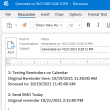
You had to work in this order:
This sounds simple but its easy to mess up: If
you closed the message first, the changes to the
attachment didn't save back to the message. Then,
if you closed the attachment without saving it to
your documents folder, all of your edits could be
lost (or hard to find in the securetemp folder).
If you saved and closed the attachment first then
closed the message but didn't save changes, the
attachment wasn't updated.
Because there were so many ways this could go
wrong, administrators generally hate this
feature.
We were curious to find out how many people used
this feature; if you haven't yet voted in our
poll, there is still time. It's fairly evenly
split, although highly unscientific.
http://www.outlookforums.com/showthread.php?68554
As with all of our polls, voting is open to
anyone but you'll need an account to comment. We
have several suggestions for better
implementation.
"HTTP status code of 403"
error when you start Exchange Management Shell on
an Exchange Server 2010 Client Access server
http://support.microsoft.com/kb/2276957
Configuring Exchange Server 2010 DAG
http://support.microsoft.com/kb/2274305
Microsoft Windows 7 clients cannot connect to
Microsoft Exchange 2007 Autodiscover SCP (Service
Connection Point) - Error 0x800710DD.
http://support.microsoft.com/kb/2291853
Exchange 2010: Get-ReceiveConnector warns that an
Exchange 2007 connector is corrupted and in an
inconsistent state
http://support.microsoft.com/kb/2291884
Unavailable Attachments When
Accepting Meeting Requests in Outlook
http://support.microsoft.com/kb/2302448
You cannot hide header information in the Reading
Pane in Outlook 2010
http://support.microsoft.com/kb/2301453
Office 2010
Click-to-Run
http://www.slipstick.com/outlook/ol2010/click-to-run.asp
The “Click to Run” version (C2R) is virtualized
and can run side-by-side with your current
installation which makes it great for trials but
there are some limitations: Outlook 2010 C2R will
not use add-ins and external programs (including
sync software)will not see Outlook C2R; for
example, mailto’s will not use Outlook 2010
because it is not registered as nor can it be the
default email client. You can switch between
either version at any time but cannot use both at
the same time. While the limitations are annoying
for regular use, it’s workable for people who
want to try Outlook or need to support Outlook
2010 but aren’t ready to move to it for daily
use.
Should you install Office 2010 32- or
64-bit?
http://www.slipstick.com/outlook/ol2010/64bit.asp
The 32-bit version of Office 2010 is the
recommended option for most users, because it
prevents potential compatibility issues with
other 32-bit applications, specifically
third-party add-ins that are available only for
32-bit operating systems
Outlook 2010 BCM
http://www.slipstick.com/bcm/problems/bcm2010.asp
Business Contact Manager is included only in the volume-license suite and as
part of a TechNet or MSDN subscription. BCM 2010 is not included in any of
the retail suites. Microsoft has this to say about possible BCM availability
in the future: "The Office Team is aware of the issues you are
experiencing because of the limited number of suites Business Contact
Manager is available. We are currently investigating possible solutions. BCM
2007 users who are upgrading to Office 2010, should contact Microsoft
Support and let support know that you have existing BCM 2007 data and need
BCM 2010. Users can click the Get Help Now link at the Outlook Solution
Center, http://support.microsoft.com/ph/14864."