Microsoft recently released Exchange Server 2010 RC1 to the public. While some minor things may change prior to the final release of the product, we can assume that most things will stay the same. The Exchange team has made a large investment into archiving, compliance, discovery, and data retention in this release, adding features such as:
This is actually a Win7 and Vista tip with an Outlook angle. It works in
older versions of Windows as well, but only with the QuickLaunch toolbar.
(Outlook 2010 uses Win7's jump list capability for shortcuts for new items.
)
A user asked this question: " I'd like to have a shortcut in my system tray
or sidebar in Win 7 so I can create a new appointment without having to open
Outlook 2007. Is this possible?"
I'll address the "without having to open Outlook" part first. Yes, you can
have shortcuts to create new items but when you use them, Outlook will open
in a hidden state. If you use an account that doesn't require you to log on,
you probably won't notice it. But if you use an Exchange account that
requires a password to access or password protect your PST file, you will
need to enter the account information or password to use a shortcut while
Outlook is closed.
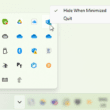
To run a shortcut in the system tray or sidebar you need to use a utility
(or a sidebar gadget). One tray utility that offers shortcuts for new items
is Knockout. It works on Win7 and with all versions of Outlook, including
Outlook 2010 x64.
Generally speaking (because they use no resources) its better to pin a
shortcut on the Start menu, on Win7's Taskbar, or add a shortcut to the
Quick launch toolbar. (Sidebar gadgets that access Outlook data are known to
cause issues with Outlook not closing properly. )
Pinned items are just shortcuts in C:\Users\<username>\AppData\Roaming\Microsoft\Internet
Explorer\Quick Launch\User Pinned. You can move or copy shortcuts from the
quick launch folder to the pinned start menu or taskbar folders.
You can easily make your own shortcuts for new items using the following
command line:
"C:\Program Files\Microsoft Office\Office12\OUTLOOK.EXE" /c IPM.APPOINTMENT
Change the path to Outlook to match your version and if you want to open
other forms, change IPM form to any valid published form.
Or use another handy little utility from Jensen Harris called QuickIcons.
This utility creates shortcuts for new Outlook item in the Quick launch
folder for you. In Win7 and Vista, the quick launch shortcuts are at
C:\Users\<username>\AppData\Roaming\Microsoft\Internet Explorer\Quick
Launch\ .
Knockout
http://sunflowerhead.com/software/knockout/
QuickIcons
http://sunflowerhead.com/software/quickicons/index.html
We had a couple of questions this week about working with hyperlinks to
files. In both cases, the users wanted to hyperlinks to files where the
folder name included the # character.
This will always fail. While the pound sign is a valid character for a
folder or file name, it is not a valid character for use in a hyperlink. In
hyperlinks, it represents a bookmark in the document.
The powershell command to remove full access permission for one account on
all mailboxes in
a database is
Remove-MailboxPermission
For more information, see
http://technet.microsoft.com/en-us/library/bb125153.aspx
Error message when a user
who has View Only Administrator permissions runs
commands on an Exchange server that has the
Client Access Server (CAS) role installed:
"Access is denied"
http://support.microsoft.com/?kbid=973620
Event 9874 is logged frequently after you install
Exchange Server 2007 Service Pack 1
http://support.microsoft.com/?kbid=967081
Microsoft Transporter Suite for Exchange Server
2007 directory synchronization overwrites custom
proxy addresses
http://support.microsoft.com/?kbid=973483
Recurring appointments in the calendar public
folder are not replicated correctly in Microsoft
Exchange Server 2007
http://support.microsoft.com/?kbid=969606
E-mail addresses are created incorrectly if an
e-mail address policy in Exchange Server 2007
contains certain symbols, a slash or a backslash,
and then another of these symbols
http://support.microsoft.com/?kbid=970893
Active Directory contacts based on SMTP addresses
are not recognized when you use the Move-DominoGroup
command to migrate from Lotus Domino to Exchange
2007
http://support.microsoft.com/?kbid=958777
Description of the Outlook
2003 Junk E-mail Filter update: September, 08,
2009
http://support.microsoft.com/?kbid=973515
Description of the Outlook 2007 Junk E-mail
Filter update: September 08, 2009
http://support.microsoft.com/?kbid=973514